Élisabeth Vigée Le Brun
Marie Antoinette's official portraitist, whose radiant brush conquered every royal court of Europe in exile.
Style and technique
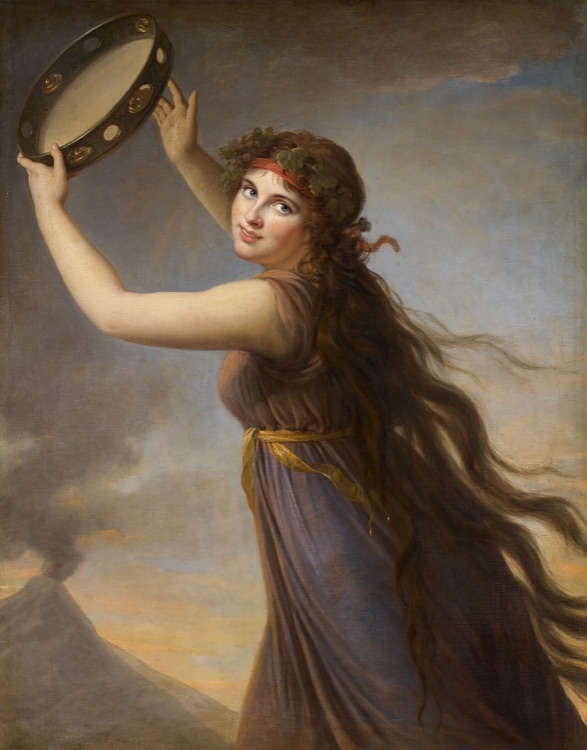
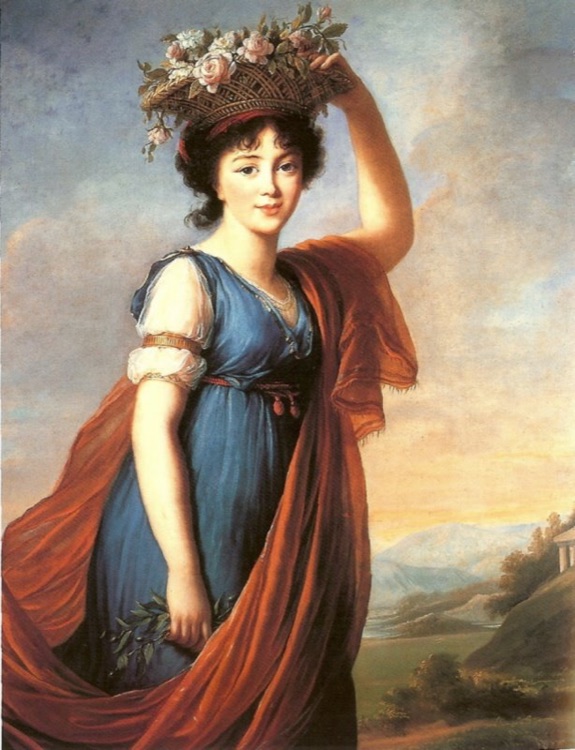
Vigée Le Brun's paintings glow with a warmth that immediately sets her apart from the powdered formality of earlier eighteenth-century court portraiture. She built her reputation on a luminous, almost translucent handling of flesh and fabric, achieved by working thin veils of color over a warm ground, so that skin seems lit from within rather than merely rendered. Where her predecessors posed sitters stiffly against columns and drapery, she loosened the formula: shoulders turn, heads tilt, hands rest naturally in laps or reach toward a child, and sitters meet the viewer's eye with an ease that reads as genuine rather than performed. This naturalism was itself a quiet argument — that dignity and elegance did not require rigidity, that a queen or a countess could be shown at ease and still command a room.
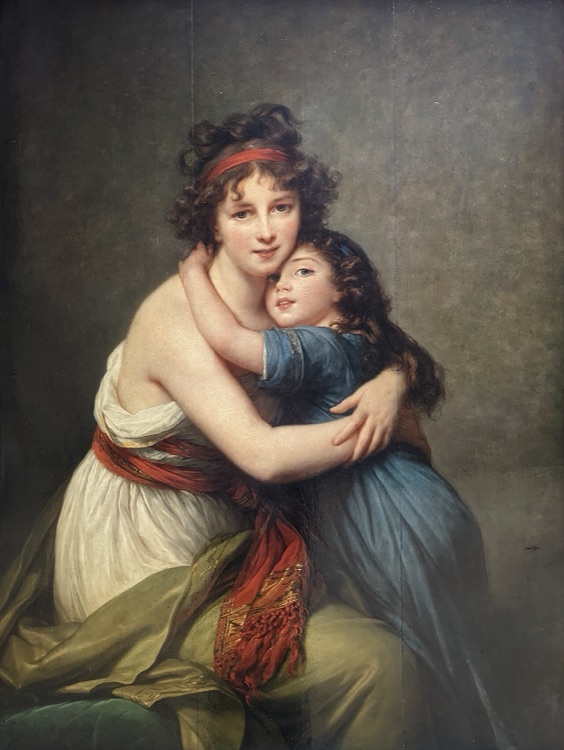
Her most personal innovation was the informal, often maternal, image: mothers and children embracing rather than posing, a straw hat replacing a court headdress, a muslin gown standing in for brocade. These choices scandalized some contemporaries — critics accused her of vulgarizing Marie Antoinette by painting her in a simple chemise — yet they anticipated the more intimate, sentimental taste of the coming Romantic era. She also had a genuine gift for self-fashioning: her self-portraits, often composed in homage to Rubens or as records of her own working process, palette in hand, project a confident professional identity rare for a woman artist of her time.
What sustained a working career that spanned revolution, exile, and the courts of Italy, Austria, and Russia was sheer technical fluency: an unfailing eye for the exact fall of light on satin, lace, or jewels, and a talent for rendering a sitter's exact likeness within a single sustained sitting, adjusting her polished formula to please Neapolitan nobility, Russian princesses, and Parisian salonnières alike, without ever losing the warmth that was unmistakably her own.
Life and legacy
Élisabeth Vigée Le Brun was born in Paris in 1755, the daughter of Louis Vigée, a modest portraitist in pastels who gave her early lessons before dying when she was twelve. Left largely to teach herself, she copied old masters in private collections, studied alongside working painters, and by her teens was already earning money painting portraits of family friends and minor nobility — so successfully that officials briefly seized her equipment because she was practicing without a license from the painters' guild. She joined the Académie de Saint-Luc instead, married the picture dealer Jean-Baptiste-Pierre Le Brun in 1776, and kept building a clientele on talent and sheer industry.
Her decisive break came in the early 1780s, when she was introduced to Marie Antoinette. The queen took an immediate liking to her, and Vigée Le Brun went on to paint her more than two dozen times over the following decade, becoming in effect the court's official image-maker at a moment when the monarchy badly needed a sympathetic public face. That royal favor also opened a door that should have stayed closed to her: in 1783, on the queen's personal intervention, she was admitted to the Académie Royale de Peinture on the very same day as her rival Adélaïde Labille-Guiard, an institution that by statute allowed only four female members at any time, submitting the allegorical Peace Bringing Back Abundance as her reception piece.
That same royal favor became a liability the moment the Bastille fell. In October 1789, days after the storming of Versailles, Vigée Le Brun fled France disguised in modest traveling clothes with her young daughter Julie, beginning more than a decade of exile during which the revolutionary government formally listed her among the émigrés and confiscated her Paris property. She turned flight into a triumphant tour: in Italy she was welcomed into the Roman, Florentine, and Neapolitan academies; she then worked her way through Vienna and Berlin before settling for six years in St. Petersburg and Moscow, where she painted the Russian aristocracy, socializing with and portraying the countesses, princesses, and grand duchesses who vied for her attention. Wherever she settled, her order books filled almost instantly.
Removed from the list of émigrés, she returned to France in 1802, resumed a quieter practice, and traveled again to England and Switzerland before retiring to Paris and her country house at Louveciennes. In her final decades she wrote her vivid, best-selling Souvenirs, three volumes of memoirs published between 1835 and 1837 that recount her sitters, her travels, and her craft with the same charm evident in her canvases. She died in Paris in 1842, having outlived the world of Versailles by half a century and left behind roughly 900 paintings, one of the largest and most admired bodies of work by any woman artist of her age.
Five famous paintings
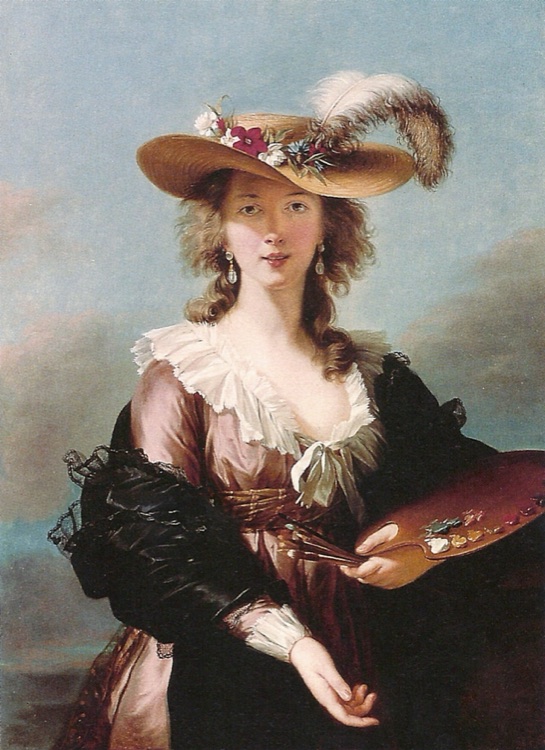
Self-Portrait in a Straw Hat 1782
Painted in Brussels as a calculated display of skill, this self-portrait shows Vigée Le Brun in three-quarter view, brush and palette in hand, wearing a wide straw hat trimmed with flowers and ostrich plumes. It was her deliberate answer to Rubens's Le Chapeau de Paille, which she had just seen and admired, right down to borrowing its play of cool shadow across the face against a warm, luminous sky. The picture doubles as a statement of professional identity: a working woman painter, confident and fashionable, unmistakably in command of her own image, made at the height of her early Parisian success.
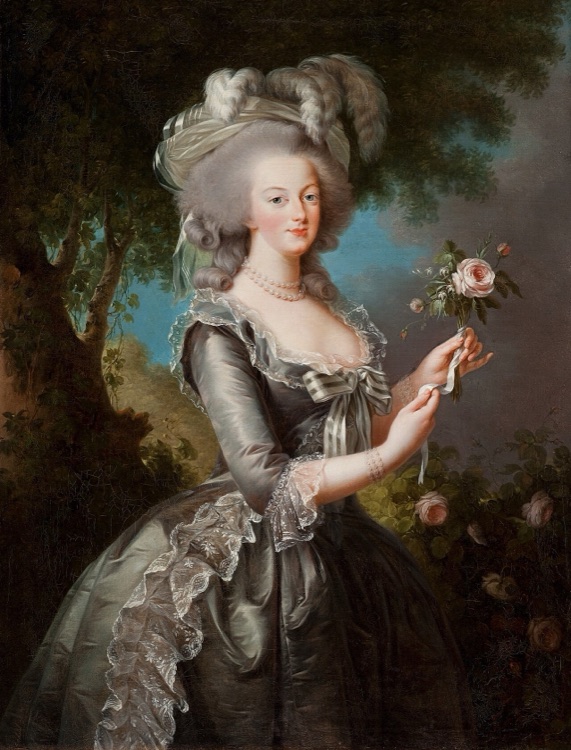
Marie Antoinette in a Muslin Dress 1783
Vigée Le Brun painted the queen not in ceremonial brocade but in a simple white muslin gaulle, a wide straw hat in one hand and a rose in the other, her hair loosely powdered rather than piled into a formal coiffure. Intended as an image of the unaffected, pastoral ease Marie Antoinette cultivated at the Petit Trianon, it instead caused a scandal when exhibited at the 1783 Salon: critics claimed the queen of France had been shown in her underclothes, and the picture was quickly withdrawn and replaced with a more conventional version. It remains the most controversial, and most telling, portrait of the fashion-conscious queen.
Marie Antoinette and Her Children 1787
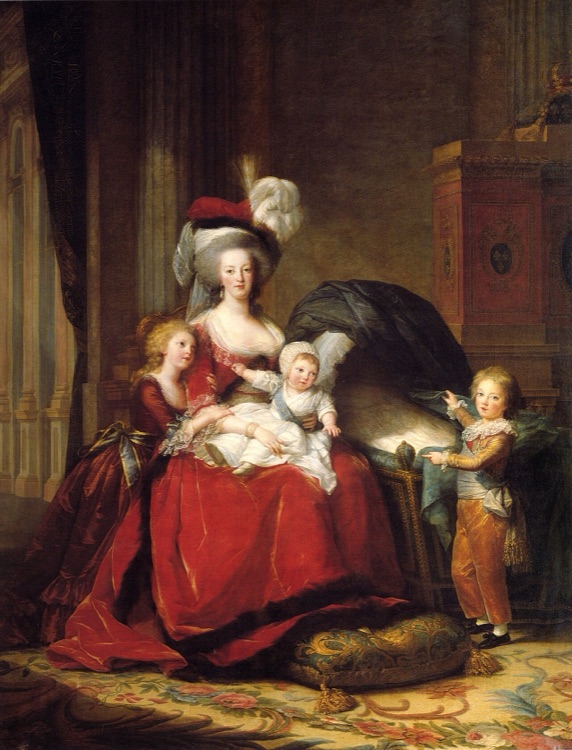
Commissioned as deliberate propaganda after years of scurrilous pamphlets against the queen, this large state portrait shows Marie Antoinette enthroned with the dauphin Louis-Joseph, Madame Royale, and the infant Louis-Charles, an empty cradle gesturing toward a recently deceased daughter. Vigée Le Brun balances grandeur with tenderness: the children lean into their mother, Madame Royale's arm around her neck, presenting the queen above all as a devoted mother rather than a foreign extravagance. Unveiled at the 1787 Salon just two years before the Revolution, it was the last great official portrait of the ancien régime's royal family.
Self-Portrait with Daughter (Julie) 1789
Painted the same year the Bastille fell, this self-portrait shows Vigée Le Brun embracing her young daughter Julie, their cheeks pressed together in a moment of unguarded maternal tenderness rather than formal display. Exhibited at the Salon just before the artist fled France, it echoes older devotional images of the Madonna and Child while asserting a thoroughly modern intimacy: loosely draped fabric, bare arms, and direct, uncomposed affection between mother and daughter. It became one of the defining images of the era's new taste for sentiment and nature over ceremony, and remains one of Vigée Le Brun's most personal and frequently reproduced works.
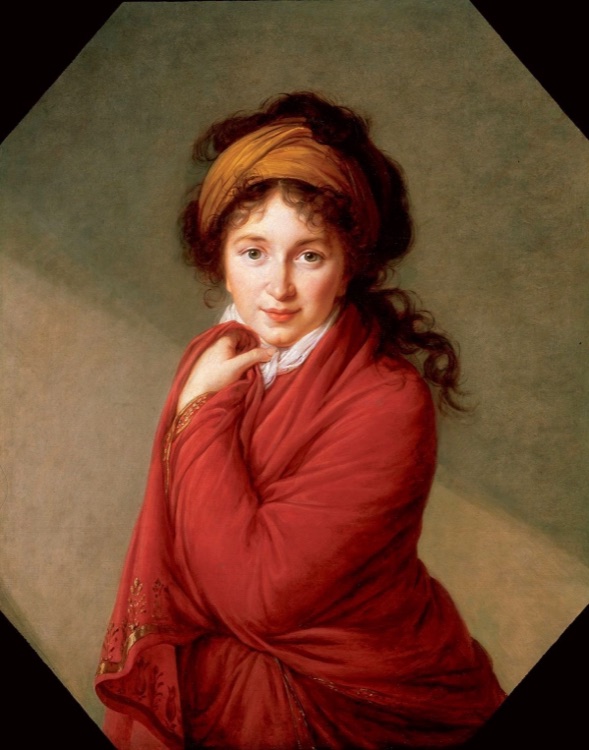
Portrait of Countess Golovina c. 1797-1800
Painted during Vigée Le Brun's long Russian sojourn, this portrait of Varvara Nikolaevna Golovina, a lady-in-waiting at the imperial court and reputed beauty, wraps its sitter in a fur-trimmed red cloak against a stormy, atmospheric sky. The countess turns toward the viewer with parted lips and a direct, almost startled gaze, one hand pulling the wrap close, in a pose that feels caught mid-motion rather than posed. The portrait shows how thoroughly Vigée Le Brun's warm, informal manner had traveled with her: a French Rococo sensibility, tempered by years of exile, applied with equal success to the Russian aristocracy.