Hilma af Klint
A Swedish mystic who mapped pure abstraction through séance visions, years before Kandinsky claimed the title.
Style and technique
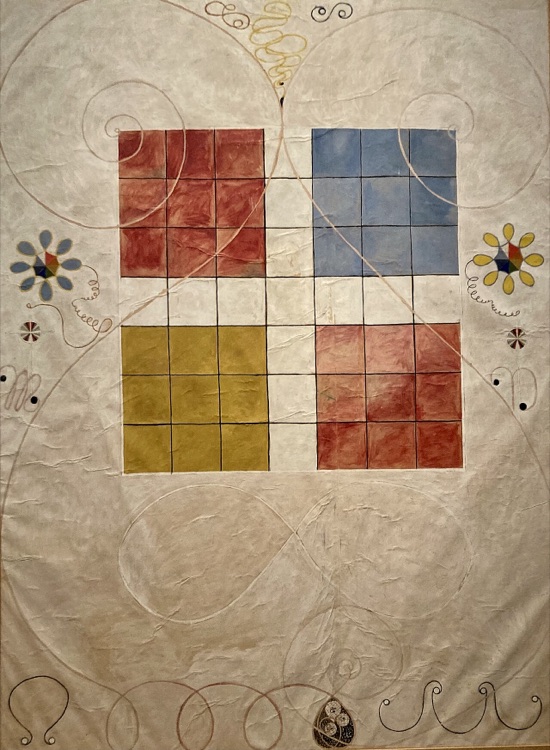
Hilma af Klint's mature work unfolds on a scale almost unheard of for a painter of her generation working outside any recognized avant-garde: canvases and paper sheets several metres tall, populated by spirals, lattices, shells, and biomorphic blooms that seem to hover between botanical drawing and pure geometry. She arrived at this vocabulary not through the incremental formal experiments of her Parisian or Munich contemporaries but, by her own account, through direct spiritual dictation. Working first through automatic drawing in séances with her circle "The Five," and later under what she described as the guidance of higher spiritual entities, af Klint treated the canvas as a receiving instrument rather than a site of personal invention — hands moving faster than conscious thought, forms arriving whole rather than composed.
Blue stands for the feminine principle, yellow for the masculine, and passages where the two interlace or resolve into rose and violet mark the union she believed underlay all creation. Recurring motifs — spirals unwinding toward infinity, paired swans locked in mirrored symmetry, doves ascending through concentric rings, trees whose branches fork into diagrams of spiritual evolution — form a private cosmology as much as a visual one, indebted to Theosophy and later to Rudolf Steiner's Anthroposophy, yet entirely her own invention.
Crucially, af Klint did not consider these works paintings for the art market, or even, at first, for public exhibition. Convinced that her true audience did not yet exist, she stipulated in her will that the abstract paintings remain unseen for twenty years after her death — a self-imposed embargo unlike anything else in modern art history, born of the same conviction that had driven the work itself: that she was a conduit for a message the world was not yet equipped to receive.
Life and legacy
Hilma af Klint was born on 26 October 1862 near Solna, Sweden, the daughter of a naval commander with a strong interest in mathematics. She showed early talent for drawing and in 1882 entered the Royal Academy of Fine Arts in Stockholm, training conventionally in portraiture, landscape, and botanical illustration. She graduated with honours in 1887 and was awarded a stipendiary studio in the city's Atelier Building, which she kept for decades. Through the 1890s and 1900s she supported herself as a working artist in the traditional sense, exhibiting and selling portraits and naturalistic landscapes in Stockholm's ordinary art circuits — work entirely distinct from what would later make her famous.
Af Klint had been drawn to spiritualism since adolescence, sharpened by the death of her younger sister in 1880, and in 1896 she formed a group with four other women — Anna Cassel, Cornelia Cederberg, Sigrid Hedman, and Mathilda Nilsson — known as "The Five." Meeting weekly, they practiced séances, automatic writing, and eventually automatic drawing, recording messages they attributed to spiritual guides they called the High Masters. In 1905 af Klint understood herself to receive a commission from one such entity, "Amaliel," to produce a cycle of paintings for a spiral temple. She began the following year, and between 1906 and 1915 produced the 193 works now known as Paintings for the Temple — starting with small, churning Primordial Chaos studies and escalating rapidly into monumental works painted at great speed, seemingly without preliminary sketches.
A 1908 studio visit from Rudolf Steiner, whose Anthroposophy she deeply admired, left her unsettled — he reportedly discouraged her mediumistic method — and she stopped painting for four years to care for her ailing mother. She resumed in 1912 with a more deliberate, though still esoteric, hand, completing the Temple cycle by 1915 and remaining active, increasingly under Steiner's influence, until her death in a road accident on 21 October 1944 in Djursholm.
Even that grace period passed largely unmarked; her nephew Erik af Klint inherited over a thousand works and notebooks that sat unstudied in storage. Only a handful of paintings appeared at the 1986 Los Angeles exhibition The Spiritual in Art, and it took the Guggenheim Museum's blockbuster 2018-19 retrospective Paintings for the Future — its best-attended show ever — to secure her current standing as one of the earliest painters of pure abstraction in the West, working years ahead of Kandinsky.
Five famous paintings
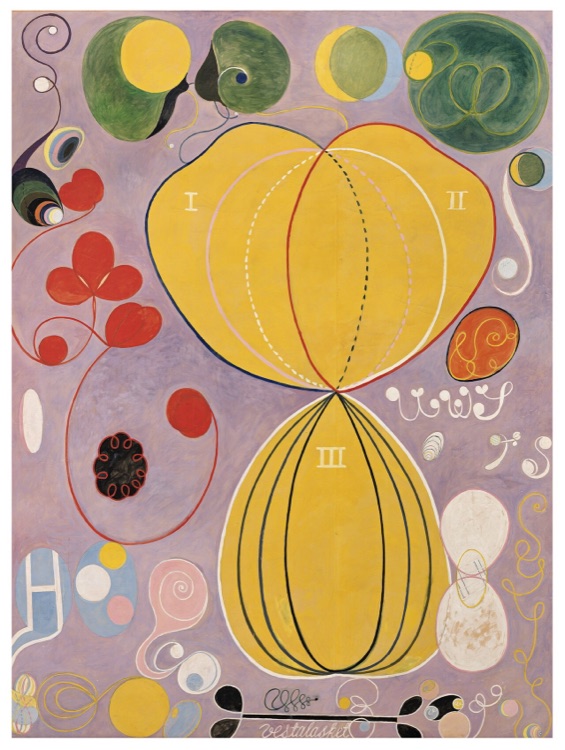
The Ten Largest, No. 7, Adulthood 1907
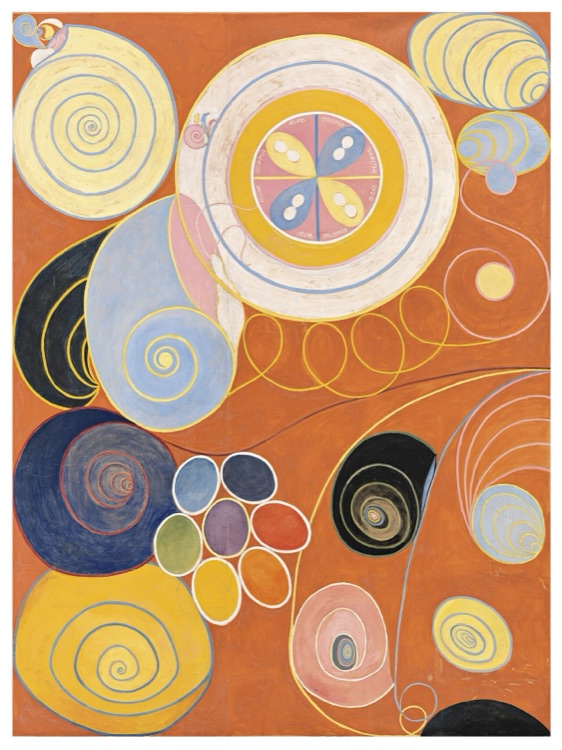
Painted in days as part of Group IV, The Ten Largest, this is one of ten canvases over three metres tall that af Klint made in 1907 to chart the four ages of life — childhood, youth, adulthood, old age — in one unbroken burst of work. No. 7 renders adulthood through interlocking spirals, looping tendrils, and soft biomorphic discs in apricot, violet, and blue, letters and numerals threaded through the composition like annotations from an unseen hand. Af Klint described working almost in a trance, forms dictated faster than she could plan — paintings that predate Kandinsky's first abstractions by years, yet stayed unseen for decades.
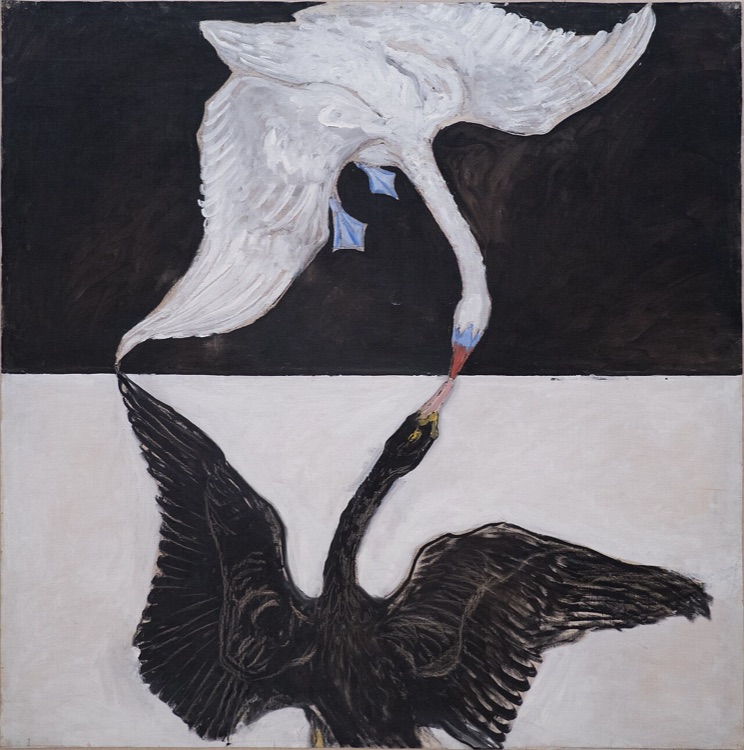
The Swan, No. 1 1915
Part of Group IX/SUW, af Klint's The Swan series, this canvas opens the sequence with a single black and white swan facing its mirrored reflection across a hard chequerboard ground. In the works that follow, the two birds dissolve into overlapping discs, triangles, and colour fields, tracking a movement from clear duality toward fused, ambiguous form. The swan carried, in the Theosophical thought she absorbed, associations with purity and transformation, and af Klint used it to stage a visual argument about polarity — light and dark, matter and spirit — resolving toward unity, rendered with the crisp, heraldic clarity of her botanical training.
Primordial Chaos, No. 16 1906-1907
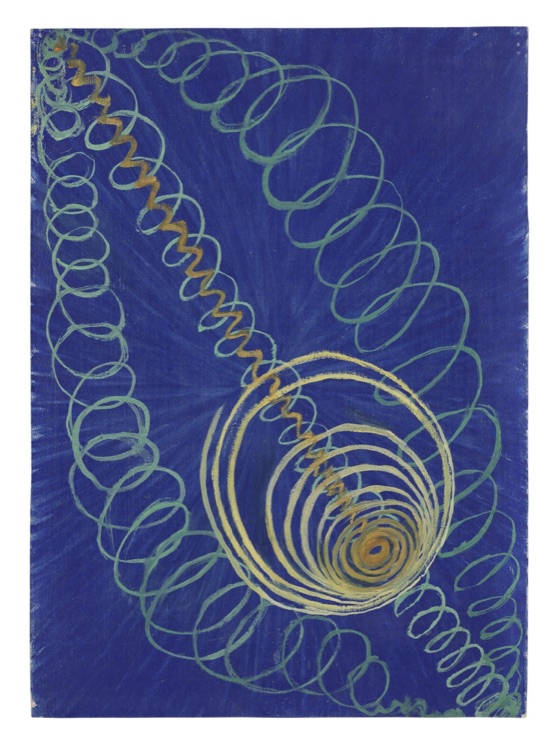
The earliest works in the Paintings for the Temple cycle, the Primordial Chaos series is modest in format but radical in what it attempts: rendering the moment before form coheres into matter. No. 16 is dominated by a tight spiral in blue and gold unfurling against a churning, cloud-like ground, with the letters "U" and "W" — shorthand af Klint used across the cycle for spirit and matter — inscribed near its edge. Painted in 1906-07, before Kandinsky, Kupka, or Mondrian made their first fully abstract works, these small canvases mark the true origin of her mediumistic practice, her hand guided faster than conscious thought could follow.
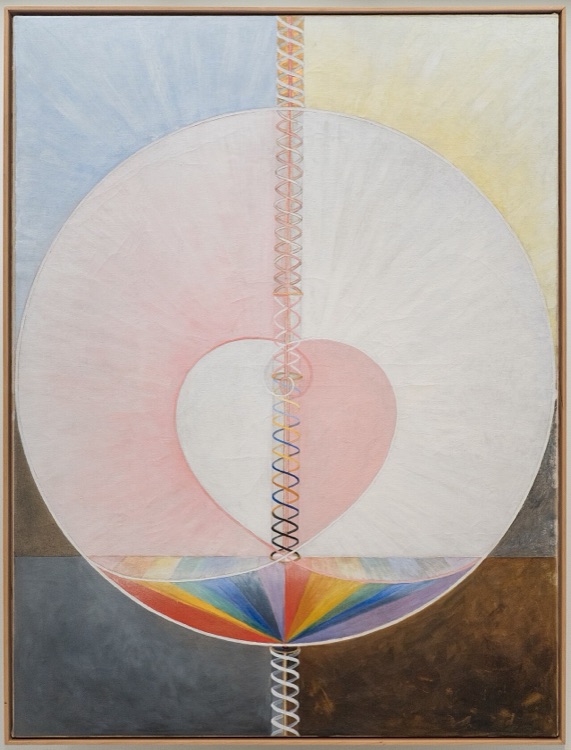
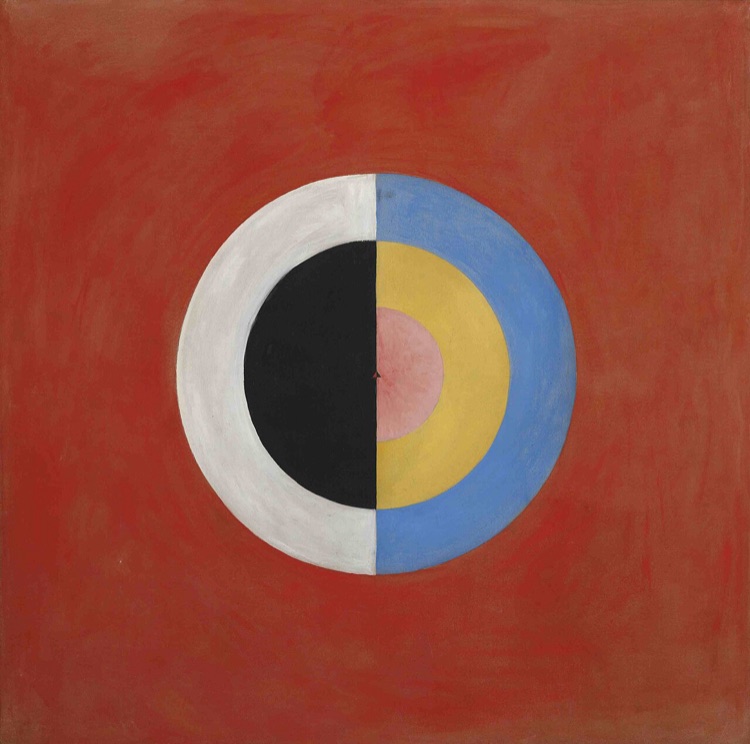
The Dove, No. 1 1915
Painted in 1915 as af Klint brought Paintings for the Temple toward its close, The Dove, No. 1 belongs to Group IX/UW, a sequence built around the bird as an emblem of spiritual ascent. Concentric rings in blue, rose, and grey radiate outward from a soft central form, the dove dissolved almost entirely into pure pattern rather than depicted representationally. By this stage af Klint worked with greater compositional control than in the trance-driven early Temple paintings, balancing mediumistic sourcing against a more deliberate, diagrammatic structure — shaped by her deepening engagement with Rudolf Steiner's Anthroposophy.
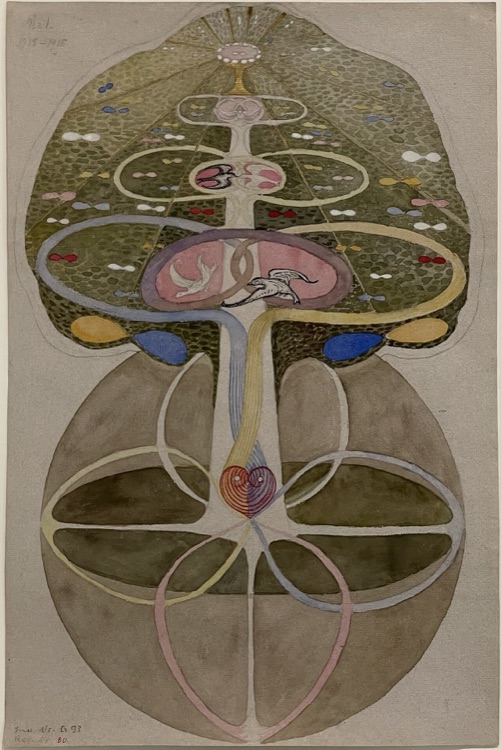
The Tree of Knowledge, No. 1 1913-1915
A set of watercolours from 1913-1915, the Tree of Knowledge series fuses the botanical draughtsmanship af Klint practiced since her academy days with the esoteric symbolism of her mature work. No. 1 shows a tree rendered with near-scientific exactness — root, trunk, branching crown — overlaid with spiralling colour bands and inset diagrams like annotations to a private cosmology of spiritual evolution. Where the giant Temple canvases were made at speed under mediumistic guidance, this smaller sheet shows her reasoning through her symbolic system by hand, bridging her training and the visionary abstraction for which she'd only become known decades later.