
Abstract Art (incl. Op Art)
When the last recognisable object disappeared — colour, line and form speak for themselves.
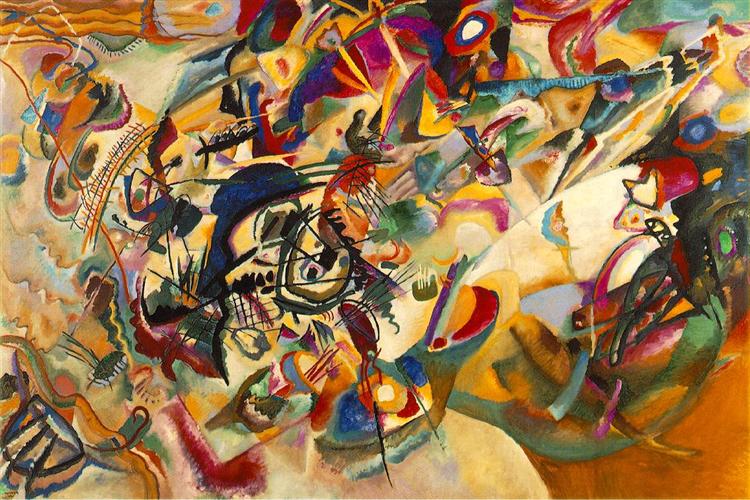
In the winter of 1910–11, Wassily Kandinsky stumbled into his own studio at dusk and found a painting of extraordinary beauty: blazing colour, mysterious forms, no subject he could identify. Reaching for his lamp, he realised it was one of his own canvases, set on its side. The anecdote — Kandinsky told it himself — may be tidied by retrospection, but the insight it encodes was real. Colour and form could carry emotional content without depicting anything. By 1913, Kandinsky had produced a series of works he called *Compositions* and *Improvisations* — the first fully abstract paintings in the Western tradition. He was not alone. In the Netherlands, Piet Mondrian was moving, step by methodical step, from observed trees through Cubist fragmentation to pure horizontal-vertical grids: by 1917, the grids he called *Neo-Plasticism* had eliminated every trace of the visible world. In Russia, Kasimir Malevich nailed a black square on a white canvas at the *0,10* exhibition in Petrograd in December 1915 and called it Suprematism — the supremacy of pure feeling over the imitation of nature. Three pioneers, three countries, three distinct approaches, all converging on the same radical conclusion: that painting could exist without a subject.
Origin and history
The roots of abstract art lie in the late nineteenth century's long argument about what painting is for. The Symbolists had claimed that art should evoke mood and spiritual states rather than describe reality. Cézanne had reduced natural forms to geometric essentials. The Fauves had freed colour from descriptive obligation. But all of these moves had preserved some connection to the visible world — a tree, a figure, a landscape, however distorted. The final step required a particular kind of intellectual courage: to believe that a painting with no object whatsoever was not merely decoration but could carry genuine meaning.
Kandinsky arrived at abstraction through a convergence of influences: Theosophy, which held that spiritual realities lay behind the physical world; Schoenberg's atonal music, which he attended in Munich in 1911 and which demonstrated that sound could be organised without reference to traditional harmony; and his own watercolour practice, where he had found that colour combinations triggered emotional responses entirely independent of subject matter. His treatise *Concerning the Spiritual in Art* (1911) was the movement's founding theoretical text, arguing that colours and forms had inherent emotional and spiritual values — blue was heavenly, yellow aggressive, red powerful.
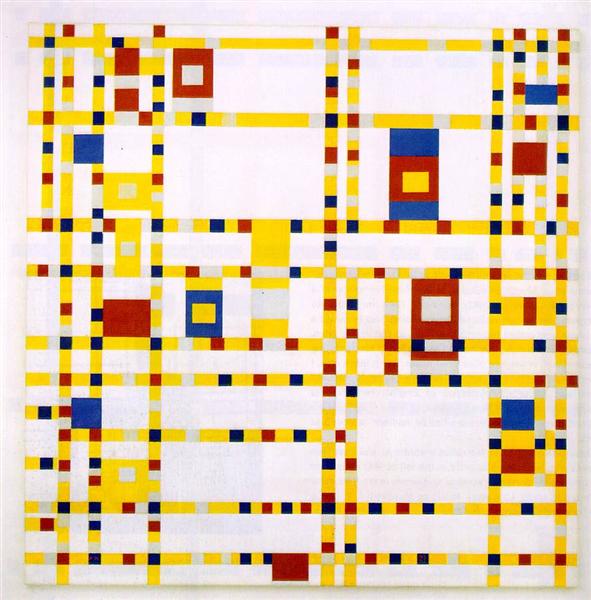
Mondrian came from a different direction — Dutch Calvinist austerity and a philosophical system called Theosophy — and arrived at abstraction through a more systematic process. His series of paintings of a single apple tree (1908–1913) is one of the most remarkable sequences in art history: from naturalistic representation through Fauvist colour, through Cubist fracturing, to a pure grid of horizontal and vertical lines. By the time he co-founded De Stijl with Theo van Doesburg in 1917, he had reduced painting to three primary colours, black, white and the right angle — a visual philosophy he called *Neo-Plasticism*.
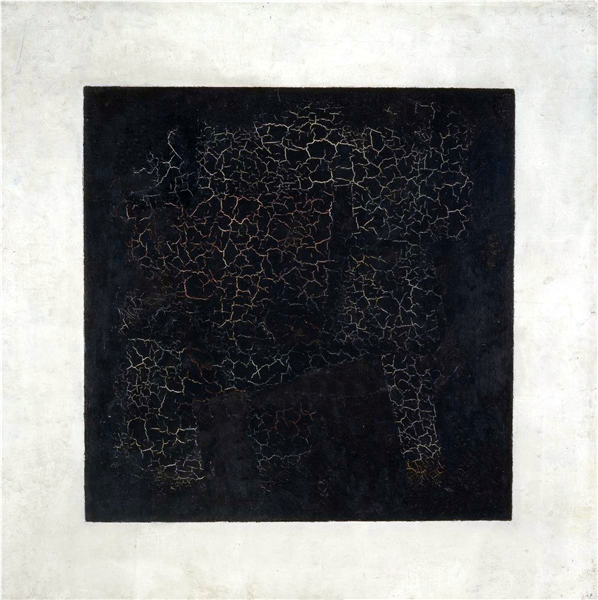
Malevich's Suprematism was the most radical of the three approaches. His 1913 work *Black Square* — which he placed in the corner of the exhibition space, traditionally the location reserved for Russian Orthodox icons — was a deliberate provocation: a declaration that art had arrived at its zero point and could begin again from pure sensation. His subsequent *White on White* paintings (1918) pushed even further, approaching the total dissolution of the picture surface.
Concept and philosophy
Abstract art is not the absence of meaning but the reassignment of meaning: from representation to form, from narrative to sensation, from the depicted world to the experience of colour, line and composition in themselves. This is a difficult claim that requires unpacking.
Every tradition of painting before abstraction had justified its formal choices — colour, composition, scale — in terms of what it was depicting. Shadows were dark because real shadows are dark; a large figure was placed in the centre because the subject was important. Abstract art cut that justification away. Red is here because red creates a particular sensation — not because the depicted object is red. The horizontal line creates calm — not because the depicted landscape has a horizon.
The three founding pioneers embodied three distinct answers to the question of what replaced representation. For Kandinsky, the answer was emotion and spirituality: abstract form was a language capable of communicating inner states directly, like music. His *Compositions* are structured like symphonies — with tensions, resolutions, climaxes. For Mondrian, the answer was universal harmony: his grids and primary colours were a diagram of the fundamental structures of the universe, beneath the chaos of visible appearances. For Malevich, the answer was pure sensation liberated from everything else: the black square was not symbolic, not emotional, but simply and completely itself.
These three answers seeded three distinct traditions within abstraction that ran through the twentieth century. Kandinsky's emotional abstraction fed *Lyrical Abstraction* and ultimately Abstract Expressionism (Rothko, de Kooning). Mondrian's rational geometry fed De Stijl, the Bauhaus and eventually Minimalism (Judd, Flavin, Martin). Malevich's radical reduction fed Constructivism (Rodchenko, Lissitzky) and the entire vocabulary of modern graphic design. The argument between these tendencies — feeling versus order, gesture versus geometry — has been one of the most productive arguments in modern art.
How to recognise it
Abstract art has no recognisable objects by definition — but its sub-genres are visually very distinct, and these six markers will tell you where within the vast territory of abstraction you are standing.
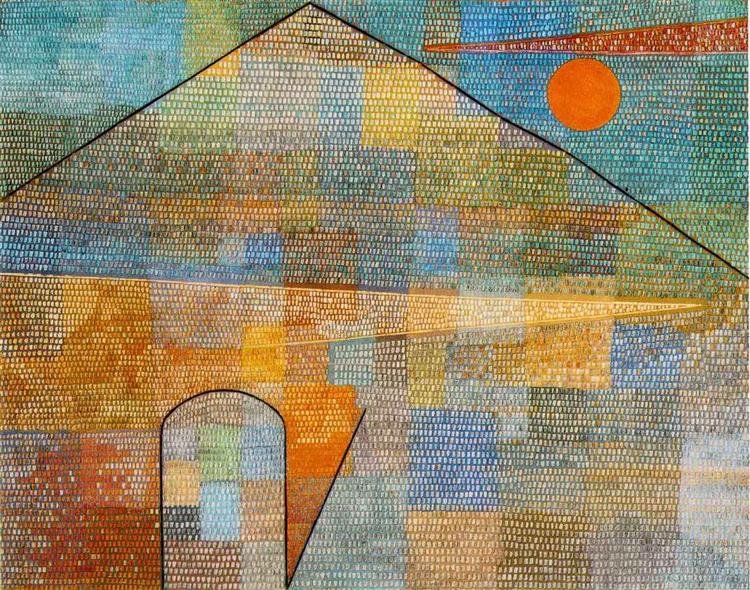
- Geometric vs. lyrical form — The most fundamental divide in abstract art. Geometric abstraction (Mondrian, Malevich, Albers) uses clean-edged, flat shapes — rectangles, squares, circles — arranged with rational precision. Lyrical abstraction (Kandinsky, Klee) curves, flows and improvises — forms that suggest organisms, musical notation or emotional states.
- Colour as primary carrier — In abstract art, colour bears the full weight of expression — there is no depicted subject to share the burden. Warm against cool, high-chroma against neutral, advancing red against receding blue: these contrasts are the painting's entire argument. Rothko's hovering rectangles work exclusively through the subtle vibration of two or three closely related tones.
- Absence of illusionistic depth — Most abstract art actively refuses pictorial depth — the illusion of a three-dimensional space receding behind the picture plane. Mondrian's grids sit firmly on the surface. Malevich's squares float on pure white grounds. Even gestural abstraction (de Kooning, Kline) tends to compress the pictorial space into a shallow zone just behind the canvas.
- Visible gesture and *impasto* — Gestural abstract painting announces its physical making: drips, splashes, raw canvas, impasto ridges. The process is the subject. This is the tradition that runs from Kandinsky's freer *Improvisations* through Abstract Expressionism (Pollock, de Kooning) to contemporary gestural painting. The speed and physical energy of the mark are legible on the surface.
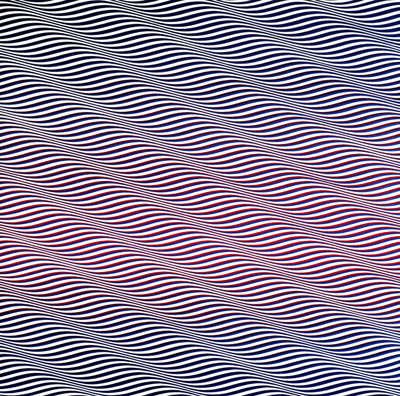
- Systematic or serial logic — Much geometric abstraction is organised by a visible rule or system: Mondrian's grids follow a strict right-angle vocabulary; Albers's *Homage to the Square* series investigates colour relationships within a fixed format; Riley's Op Art patterns generate optical effects through precise, systematic repetition. The painting demonstrates a proposition rather than expressing a feeling.
- Scale as content — Many canonical abstract works are very large — not to impress but because scale changes the viewer's experience of colour and form. Standing before a Rothko whose edge extends beyond your peripheral vision, you are inside a colour field rather than looking at one. The physical encounter is the work. Abstract art frequently uses scale as a formal argument in itself.
Anecdotes and curiosities
Mondrian could not tolerate the colour green. His biographers record that Mondrian refused to have any green objects in his apartment — plants, furniture, any natural greenery — on the grounds that he had pushed green entirely out of his pictorial world and found it aesthetically intolerable in his life as well. When his New York studio on East 59th Street was photographed shortly before his death in 1944, the walls were covered in large painted squares of primary colour and the only plants visible were artificial flowers he had painted red. He had cut himself a square window in one wall so he could not see the trees in the street.
**Malevich placed his *Black Square* in the icon corner.** At the *0,10* exhibition in Petrograd in December 1915 — the first public showing of Suprematist work — Malevich hung his *Black Square* (1915) in the upper corner of the gallery, the position traditionally reserved in Russian homes for Orthodox icons. The gesture was deliberate: it declared that abstract art had replaced religious art as the locus of the transcendent. Contemporary critics were simultaneously furious and fascinated. The original *Black Square* has cracked severely over time, revealing two earlier compositions beneath the black paint.
Kandinsky and Schoenberg exchanged paintings for musical scores. The two men — who met in Munich in 1911 after Kandinsky attended a Schoenberg concert and experienced what he described as a revelation of sound's capacity to transcend conventional harmony — maintained a correspondence and friendship for years. They exchanged works: Schoenberg sent Kandinsky musical manuscripts and Kandinsky sent paintings. Both men were convinced that their respective arts were reaching for the same spiritual goal through different material means. Kandinsky's *Yellow Sound* (1912) — a stage composition conceived for simultaneous music, movement and colour — remains one of the most ambitious attempts to realise this convergence.
Josef Albers ran colour experiments by asking students to trade colour chips. At the Bauhaus in Dessau (1923–33) and later at Black Mountain College and Yale, Albers developed a method of teaching colour perception that required no artistic talent: students simply traded small coloured paper chips — moving them side by side, layering them, placing them on different grounds — until they could see with their eyes how the same colour appears to change in different contexts. His book *Interaction of Color* (1963), based on these experiments, remains one of the most influential texts on colour perception ever written and is still used in design and fine art programmes worldwide.
Legacy and influence
Abstract art's legacy is so pervasive that it has become almost invisible. The twentieth century's most ubiquitous visual language — graphic design, corporate identity, poster art, typographic layout, architectural surface, product packaging — is built on the formal discoveries of Mondrian, Malevich, Kandinsky and their immediate successors. The grid that organises this web page; the primary-colour logo on your coffee cup; the geometric simplicity of a well-designed chair — all descend in a direct line from the studios of Zurich, Munich, Amsterdam and Petrograd in the 1910s and 1920s. Within fine art, abstract painting generated the century's most intellectually serious movements: the Bauhaus (which turned abstract principles into a pedagogy), Constructivism (which applied them to social and political transformation), De Stijl, Abstract Expressionism, Minimalism, Op Art. The argument between expression and order — Kandinsky versus Mondrian, gesture versus geometry — remained the central debate in painting throughout the twentieth century and has never been definitively resolved. Abstract art also permanently changed what we expect of the viewer: without the anchor of representation, looking actively — constructing meaning from colour and form rather than reading a depicted narrative — became a skill the modern spectator had to learn.
8 artists in this movement
Frequently asked questions
When was the first abstract painting made?
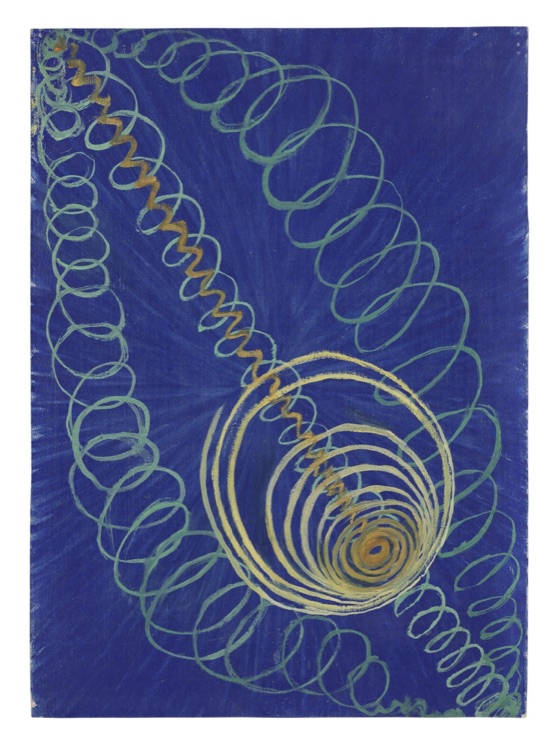
The question is contested. Kandinsky's watercolour of 1910 (now in the Centre Pompidou) is the most commonly cited candidate — a loose, purely non-representational work he may have made as an experiment. Mondrian's grids reached full abstraction by around 1917. Malevich's *Black Square* was exhibited in 1915. Earlier claims have been made for Hilma af Klint, a Swedish painter whose large abstract works from 1906–08 were kept hidden until after her death — a case that has been significantly reassessed since the 2010s.
What is the difference between abstract and non-objective art?
The distinction is useful but not always observed. Abstract art technically refers to work that begins with a representation and moves away from it — retaining some residual connection to observed reality. Non-objective art starts with no representational intention at all: pure form, pure colour, pure sensation. In practice, Mondrian and Malevich are non-objective; early Kandinsky is abstract in the technical sense. The terms are now often used interchangeably.
Who were the Bauhaus painters?
The Bauhaus school (Weimar 1919–25; Dessau 1925–32; Berlin 1932–33) united fine art, craft and design under one roof. Its painting masters included Paul Klee (1879–1940), whose work moves between lyrical abstraction, symbolic imagery and a child-like graphic poetry; Wassily Kandinsky (1866–1944), who taught the foundational colour and form course; and Josef Albers (1888–1976), whose *Homage to the Square* series became a definitive investigation of colour perception. László Moholy-Nagy and Herbert Bayer extended Bauhaus principles into photography, typography and film.
What is Op Art?
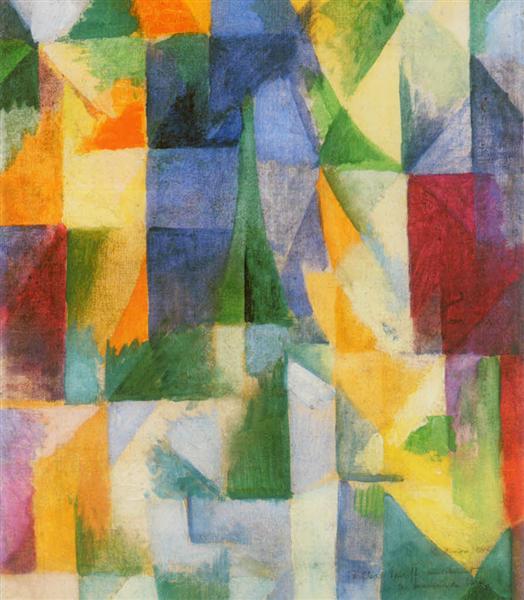
Op Art (Optical Art) is a branch of geometric abstraction that exploits the physiology of vision to create the illusion of movement, vibration or impossible depth. Bridget Riley (b.1931) and Victor Vasarely (1906–1997) are its most celebrated practitioners. The technique depends on precise, systematic repetition of geometric elements — stripes, circles, grids — whose slight variations trigger perceptual instability. The effect is created in the viewer's eye and nervous system, not in the paint: the canvas is perfectly still.
Why did the Soviet authorities ban abstract art?
After an initial period in which abstract and Constructivist art was embraced as the visual language of the revolution, the Soviet state under Stalin began promoting Socialist Realism as official doctrine from around 1932 onward. This demanded art that was representational, optimistic, politically instructive and accessible to the masses. Abstract art was condemned as bourgeois formalism — an art that served no social function and communicated only to a cultural elite. Many of the movement's most important figures — Malevich, Rodchenko, Lissitzky — were marginalised, forced to recant or killed. Malevich spent time in prison and died in poverty in 1935.