Thomas Gainsborough
England's silvery-toned virtuoso, torn between painting Georgian high society and his true love, landscape.
Style and technique
Where his great rival Sir Joshua Reynolds built up portraits in careful, considered layers, Gainsborough attacked the canvas with long, loaded brushes—sometimes six feet in length, so contemporaries claimed—standing well back to gauge the effect from a distance. The result is a signature feathery, fluttering touch: silks that seem to rustle, foliage that dissolves into flicker and haze, faces modeled with quick, confident strokes rather than smooth blending. Fabric, hair, and leaves are rendered with the same restless energy, so that a satin gown and a stand of trees can feel like variations on a single, unifying rhythm.
His palette is equally distinctive: cool, silvery, and pearlescent, built from blues, greys, and soft greens rather than the warm ambers favored by Reynolds. Even flesh tones in his portraits carry a faint bloom of blue-grey shadow, lending his sitters a delicate, almost porcelain refinement. This silvery key owes much to his lifelong study of Van Dyck, whose elegant, elongated poses and shimmering satins Gainsborough absorbed and updated for a Georgian audience; his sitters often stand in the loose contrapposto and languid grace of seventeenth-century court portraiture, dressed at times in deliberately old-fashioned Van Dyck dress to signal refinement and pedigree.
What truly set him apart, however, was his refusal to treat the human figure and the landscape as separate problems. Reynolds subordinated setting to sitter; Gainsborough wove them together, dissolving the boundary between portrait and landscape so that figures seem to breathe the same misty, atmospheric air as the trees and clouds behind them.
He complained to friends that he was sick of portraits and longed to take his viola da gamba and retreat to some sweet village to paint landskips for pleasure. Portraiture paid his bills and built his fame; landscape fed his imagination, and its influence saturates even his grandest society portraits, which glow with an unmistakably personal, poetic light.
Life and legacy
Thomas Gainsborough was born in 1727 in Sudbury, Suffolk, the youngest son of a cloth merchant, in a landscape of gentle rivers, windmills, and farmland that he would sketch obsessively as a boy and never stop painting, in one form or another, for the rest of his life. Recognizing his talent, his family sent him to London around 1740, where he trained under the French engraver Hubert Gravelot and absorbed the rococo elegance of French printmaking alongside the example of seventeenth-century Dutch landscapists and Van Dyck's aristocratic portraiture. By his late teens he was working independently, and in 1746 he married Margaret Burr, reputedly the illegitimate daughter of a duke, whose modest annuity offered the young couple some financial cushion.
Gainsborough set up practice first in Sudbury and then, in 1752, in the busier market town of Ipswich, painting small, sensitively observed portraits of local gentry and merchants while pursuing landscapes for his own satisfaction. His decisive move came in 1759, when he relocated to the fashionable spa town of Bath. There, surrounded by wealthy visitors seeking portraits as souvenirs of their stay, he refined his mature style—the feathery brushwork, silvery tonality, and Van Dyck-inspired elegance that would define his career—and became one of the most sought-after portraitists in Britain, rivaled only by Sir Joshua Reynolds in London.
In 1768 Gainsborough was named a founding member of the Royal Academy, but his relationship with the institution was fraught from the start. He clashed repeatedly with the Academy's hanging committee over the placement and lighting of his pictures, and in 1784, after a bitter dispute, he withdrew his works from its annual exhibition altogether, opting instead to show privately at his own house. That same decade he moved permanently to London, settling near Reynolds in Pall Mall, where the two men maintained a rivalry equal parts professional competition and grudging mutual respect—Reynolds prized draftsmanship and classical composition, Gainsborough spontaneity and painterly bravura.
Gainsborough died of cancer in London on 2 August 1788.
Reynolds himself later paid tribute to his rival's genius in a Royal Academy discourse, acknowledging what generations of viewers have since agreed: that Gainsborough's finest landscapes and portraits alike possess a freshness and lyricism no contemporary could match.
Five famous paintings
Mr and Mrs Andrews c. 1750
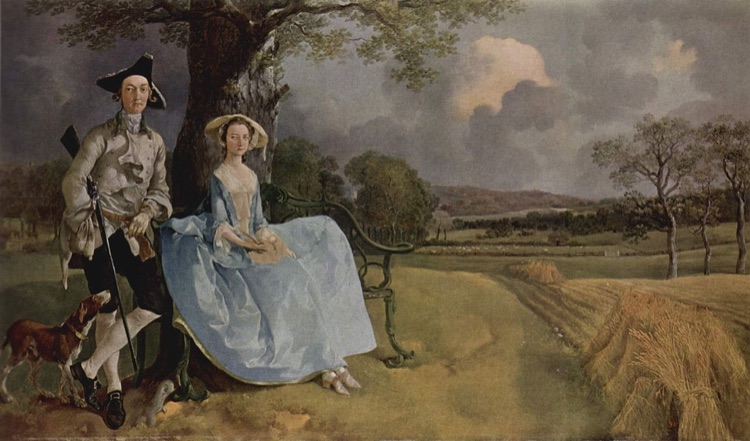
Painted shortly after Gainsborough's marriage, this double portrait of a young Suffolk squire and his bride pairs a crisp, faintly stiff likeness of Robert and Frances Andrews with a sweeping, precisely observed view of their own freshly harvested farmland. The couple, in fashionable silk and Van Dyck-tinged elegance, occupy barely a third of the canvas; the rest belongs to sheaves of wheat, grazing sheep, and a golden Suffolk sky. Long thought unfinished because of the blank patch on Mrs. Andrews's lap, it remains the clearest early statement of Gainsborough's instinct to fuse portraiture and landscape into one seamless vision.
The Blue Boy c. 1770
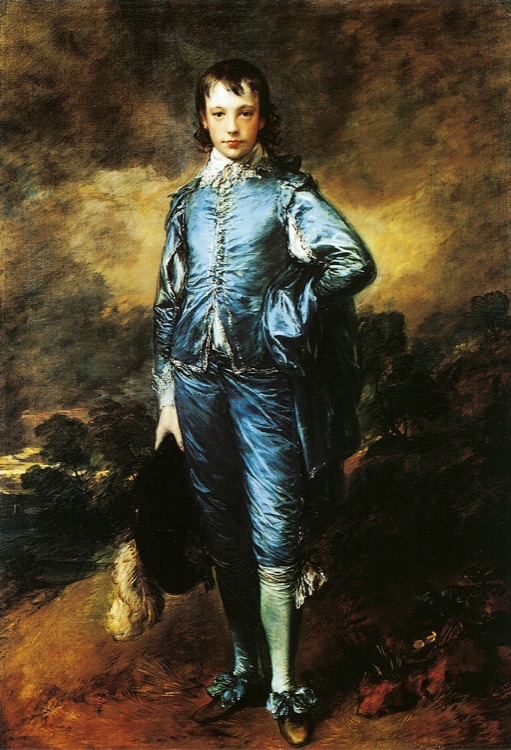
Gainsborough's most famous single image, this full-length portrait of a boy in shimmering blue satin was, by tradition, painted partly to defy Reynolds's academic rule that cool blues should never dominate a composition—hence its later nickname. The sitter, generally identified as Jonathan Buttall, son of a wealthy merchant, wears a lavishly antiquated Van Dyck costume, complete with slashed sleeves and plumed hat, posed against a darkly wooded landscape. The bravura handling of the satin—loose, flickering strokes that cohere into rustling fabric—remains one of the most virtuosic passages in eighteenth-century British painting.
The Morning Walk 1785
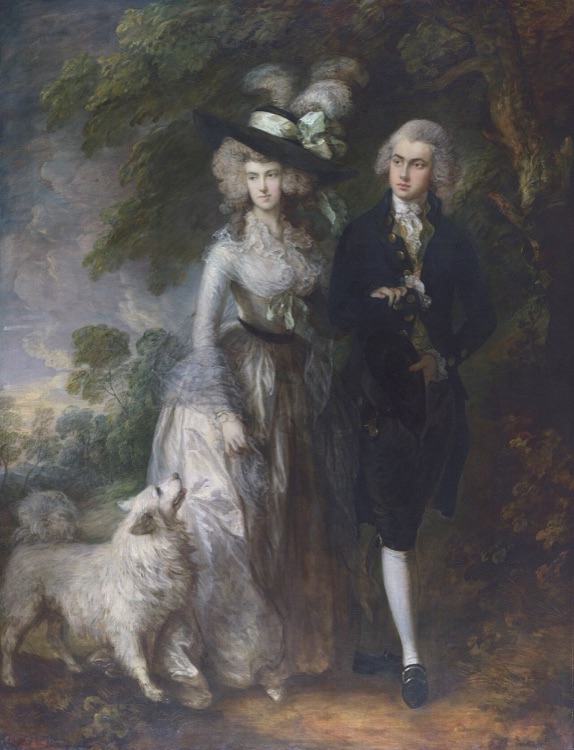
One of Gainsborough's last and most lyrical portraits shows the newly married William and Elizabeth Hallett strolling arm in arm through a silvery, wind-stirred wood, their Pomeranian trotting alongside. Painted as a wedding portrait, it dissolves the boundary between sitter and setting more completely than almost anything else he made: the couple's pale, feathery-brushed clothing seems spun from the same soft atmosphere as the trees around them, all bathed in the cool, pearlescent light that became his signature. There is little formal grandeur here, only an intimate tenderness between two people and a landscape that seems to breathe around them.
The Painter's Daughters Chasing a Butterfly 1756
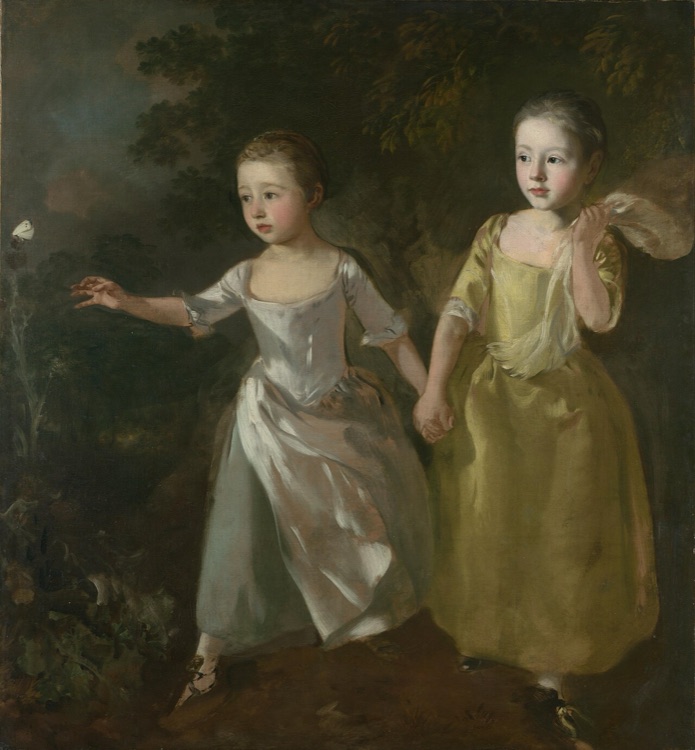
Gainsborough's own young daughters, Mary and Margaret, run hand in hand through dappled grass, the elder reaching toward a butterfly perched on a thistle while her little sister holds back, caught mid-step in a moment of genuine childhood absorption. Painted purely for love rather than a fee, this is among the tenderest images Gainsborough ever made — loosely brushed, deliberately unfinished at the edges, and utterly free of the formal poses and grand settings he had to supply his paying clients. It shows the private, informal side of a painter whose public reputation rested on polished aristocratic portraiture, and offers a rare glimpse of real affection rather than commissioned elegance.
The Watering Place 1777
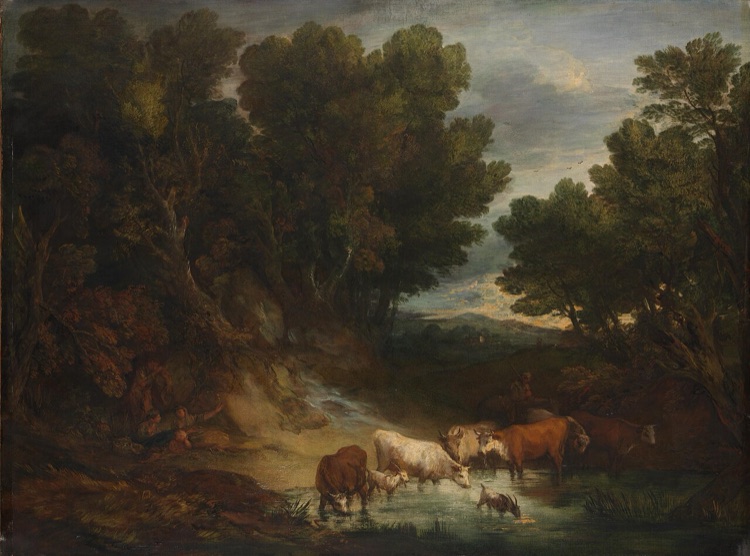
Exhibited at the Royal Academy in 1777 to considerable acclaim, this large, richly wooded landscape—cattle and herdsmen pausing at a shadowed pool beneath overhanging trees—shows Gainsborough's landscape art at its most ambitious and public. Inspired by the Dutch and Flemish masters he studied since youth, especially Rubens, it abandons portraiture for the subject he confessed he loved best: rustic scenery steeped in deep shadow and silvery evening light. Contemporaries, more used to his portraits, were startled by its scale; today it stands as proof that behind the fashionable portraitist stood an artist who considered landscape his true vocation.