
Surrealism
Dalí melted the clocks; Magritte renamed the pipe — reality was never the safe option.
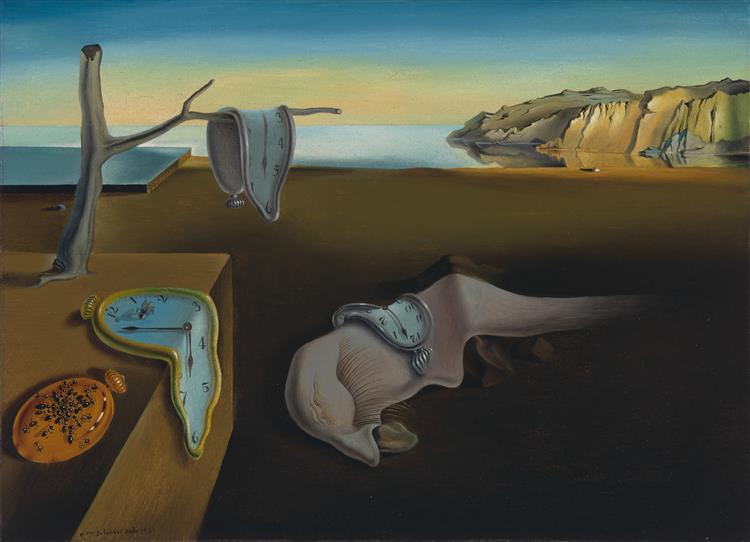
In the winter of 1931, Salvador Dalí stretched a canvas barely larger than a hardback book on an easel in his studio in Cadaqués and painted, from a hallucination triggered by a melting piece of Camembert cheese, four soft watches draped over a cliff edge and a dead tree. *The Persistence of Memory* would become the most recognised Surrealist image in the world — and it was finished in two hours. Surrealism had been declared an official movement in Paris seven years earlier, when the poet André Breton published his first manifesto in 1924, borrowing Freud's concept of the unconscious and turning it into an artistic programme. Painting, according to Breton, had wasted centuries depicting the visible surface of reality when the real action was happening underneath — in dreams, slips, obsessions and free-floating desire. The painters who answered his call — Dalí and Magritte with their hyper-realistic impossible scenes, Miró and Ernst with their improvised biomorphic forms, Frida Kahlo with her unflinching autobiographical mythology — produced some of the most unsettling and indelible images of the twentieth century.
Origin and history
Surrealism was born in Paris in 1924, though its roots reach back to the nihilist eruptions of Dada and to the proto-Surrealist piazzas of Giorgio de Chirico, whose dreamlike Italian squares — impossibly long shadows, distant trains, faceless mannequins — had been haunting European painters since 1910. When the First World War ended, a generation of artists and writers in Paris concluded that rational civilisation had just murdered ten million people and needed to be fundamentally rethought. Dada, the anti-art response coordinated around Hugo Ball's Cabaret Voltaire in Zürich from 1916, had proposed destruction as its programme. Breton wanted something more ambitious: a systematic exploration of the unconscious as the only territory that bourgeois rationalism had not yet conquered and ruined.
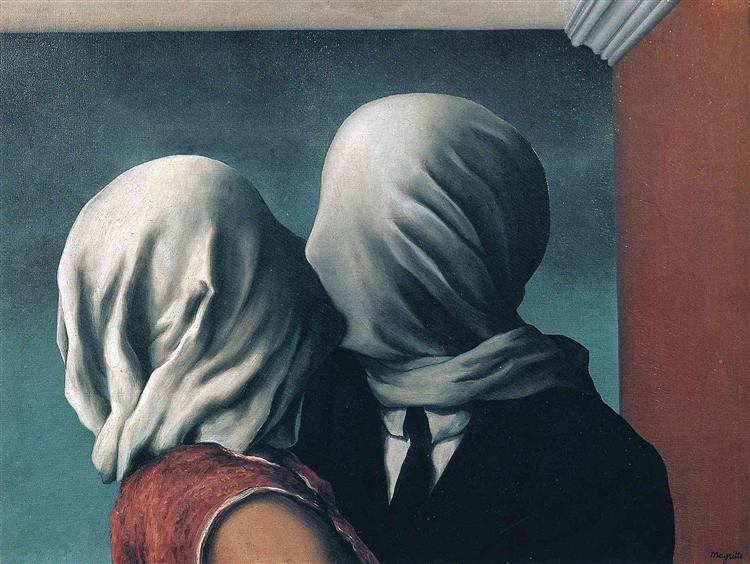
Breton's first Surrealist Manifesto of 1924 defined the movement as "psychic automatism in its pure state" — the dictation of thought without any rational control or moral preoccupation. Two distinct painterly responses emerged almost immediately. Veristic Surrealism, practised by Dalí, Magritte, Paul Delvaux and the early de Chirico, used oil paint handled with almost academic precision to depict logically impossible scenes: Magritte's bowler-hatted men with their faces replaced by apples or doves, Dalí's crutched, liquefying figures under a Catalonian sky bleached white by noon. Automatist Surrealism, adopted by Joan Miró, Max Ernst and André Masson, used chance operations — Ernst's *frottage* (rubbing pencil over textured surfaces) and *décalcomanie* (pressing pigment between sheets) — to generate imagery the conscious mind had not planned. Both streams attracted an extraordinary roster of talent: Yves Tanguy with his barren seascapes populated by amorphous forms, Meret Oppenheim with her fur-lined teacup, Frida Kahlo in Mexico City painting her surgeries and miscarriages with the clinical detachment of a field surgeon.
The movement's second decisive phase came with the exodus from Europe in 1940–41, as the Nazi occupation drove most of its major figures to New York. Ernst, Breton, Tanguy, Matta and others gathered in Manhattan, where their contact with a younger generation of American painters — Pollock, Gorky, Motherwell — fertilised what would become Abstract Expressionism. Surrealism in its Parisian, dogmatic form never fully recovered after the war; Breton's quarrelsome excommunications and the movement's irreducibly European literary character made it difficult to transplant. But the images it had produced — and the permission it had granted to paint from the inside of the mind outward — proved impossible to contain.
Concept and philosophy
What Surrealism proposed, at its philosophical core, was a redefinition of reality itself. Breton had read Freud carefully and accepted the central claim: that conscious, waking experience is only a thin film over the vast churning ocean of unconscious life, and that the contents of that ocean — dreams, compulsions, irrational associations — are more truthful about the human condition than anything the rational mind produces. The proper subject of art, then, was not the visible world but the psychological one.
For the veristic Surrealists, this meant constructing the logic of dreams on canvas with the technique of the old masters. Dalí studied Vermeer and Meissonier; his surfaces are as smooth and precise as a Flemish miniature. The images are impossible, but the paint handling makes them inarguably present — the melting watch, the burning giraffe, the figure with a drawer in its torso are all rendered with the same meticulous care as a Dutch still life. The effect is deeply disturbing precisely because the technique refuses irony; it insists that you are looking at something real.
For the automatists, the method was the message. If rational control was the enemy, then the way to access unconscious truth was to bypass the controlling hand entirely: to draw without looking at the paper, to drop paint from a distance, to rub a pencil over a random surface and see what images emerged from the noise. Ernst's forests and petrified cities, Miró's primary-colour biomorphs dancing against flat grounds — these are images that arrived by accident and were then developed, recognised and refined. The painter becomes an archaeologist of their own subconscious.
Both strategies shared a conviction that the juxtaposition of incompatible realities was where meaning was generated. The poet Pierre Reverdy had put it precisely in 1918: "The more distant and precise the relationship between two juxtaposed realities, the stronger the image." A fur-lined teacup, a rainy day indoors, an umbrella on a dissecting table — these images derive their power from exactly that distance between their components. Surrealism taught the twentieth century to read meaning from dissonance, and that lesson has never been unlearned.
How to recognise it
Six visual patterns that recur across Surrealist painting — from Dalí's sunbaked Catalonia to Magritte's overcast Brussels, from Miró's Barcelona primaries to Kahlo's Mexican self-mythology.
- Photographic realism, impossible content — The veristic Surrealists painted their impossible scenes with the smooth, detailed technique of academic realism — no visible brushwork, no expressive distortion. If a painting is technically flawless but logically absurd, you are almost certainly in Surrealist territory. The contrast between the *how* and the *what* is the point.
- Dream-logic space and scale — Surrealist paintings inhabit an airless, theatrical space — deep perspectives receding to sharp horizons, noon-harsh lighting that casts impossible shadows, figures placed at incongruous scales relative to each other or to their settings. De Chirico's *metafisica* piazzas were the template; Dalí and Delvaux perfected the uncanny open stage.
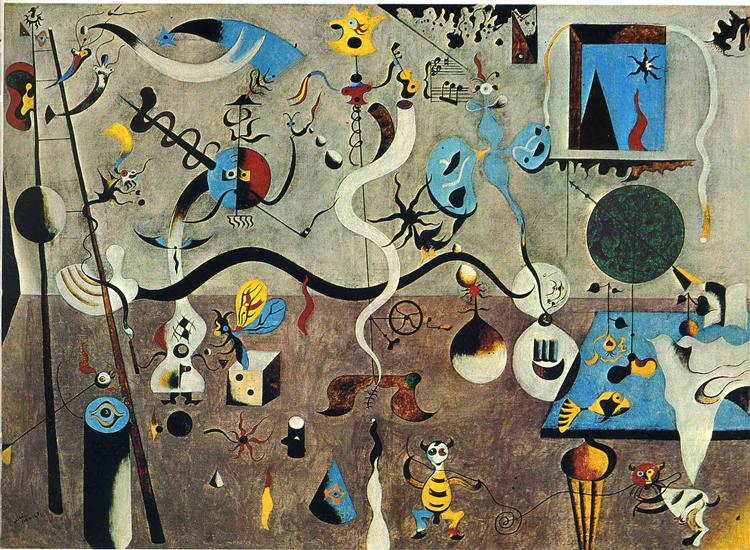
- Biomorphic and automatist forms — In automatist Surrealism, look for biomorphic shapes — organic blobs, amoebic curves, forms that vaguely suggest bodies, eyes, organs — generated by chance operations rather than conscious design. Miró's coloured spots and wiggling lines, Ernst's rubbings and pressings: imagery that looks improvised because it was.
- Symbolic and autobiographical objects — Surrealist paintings are dense with loaded objects: eggs, bones, mirrors, ants, clocks, keys, drawers embedded in torsos. These objects carry consistent symbolic weight across a painter's work — Dalí's ants signal putrefaction and desire; Magritte's bowler hat signals bourgeois anonymity. Learn the vocabulary and you can read the paintings like texts.
- Unsettling colour register — Veristic Surrealism often uses a palette that feels slightly *wrong*: too bleached under a noon sun, or sickly twilight-blue, or colours that are individually correct but combined in combinations the eye finds disturbing. The light in a Dalí often has the specific quality of a landscape just before a thunderstorm — overlit and hollow.
- Hybrid and transformed figures — The figure under transformation is a Surrealist constant: bodies that become furniture, faces replaced by fruit, women morphing into horses or pianos. Magritte used this more philosophically; Ernst and Kahlo more viscerally — Kahlo's surgical self-portraits show a body that is simultaneously subject and dissection specimen, observer and observed.
Anecdotes and curiosities
Dalí used to fall asleep holding a key over a plate. His method for inducing hypnagogic imagery — the visions that flash in the seconds between waking and sleep — was deliberately physical: he would sit in a chair holding a heavy metal key between his fingers over a tin plate on the floor. When he fell asleep, the key would drop, the clatter would wake him, and he would immediately paint whatever image had crossed his mind in that threshold moment. He called this technique "slumber with a key" and wrote about it in his 1948 book *50 Secrets of Magic Craftsmanship*. The melting watches of *The Persistence of Memory* are said to have arrived by a related route.
Magritte kept the most radical ideas behind the most suburban façade. He lived in the same modest terraced house in Jette, Brussels, for most of his adult life, wore a bowler hat and suit daily, and painted in his dining room while his wife Georgette did the housework — the oil paint and the cooking smell reportedly mingled constantly. Visitors expecting a flamboyant Surrealist found a punctilious Belgian bourgeois who kept regular office hours. The image of a bowler-hatted man that recurs throughout his work was always, Magritte insisted, an image of anonymity and invisibility — the uniform of a man so ordinary he has ceased to be seen. He painted himself in the bowler hat in several self-portraits.
Max Ernst was expelled from the Surrealist movement — and carried on regardless. Breton was a notoriously dogmatic leader who excommunicated members for political or personal transgressions, and Ernst fell from favour in 1954 partly because he had accepted the Grand Prize for Painting at the Venice Biennale — an official recognition Breton considered a capitulation to the establishment. Ernst's reaction was characteristic: he continued working with exactly the same methods, the same obsessive imagery of forests, birds and ancient ruins, and kept painting into his eighties. His *frottage* technique — discovered by accident in 1925 when he became fixated by the grain patterns of a wooden floor — remained his primary generative tool for six decades.
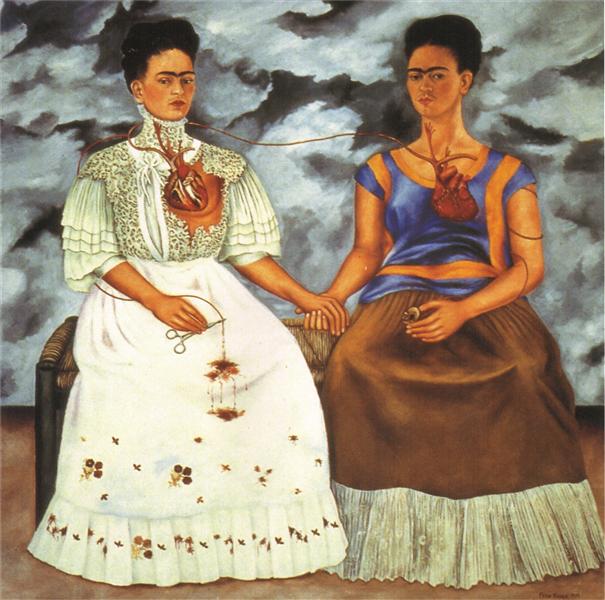
Frida Kahlo called her paintings not Surrealist but simply honest. When Breton visited Mexico City in 1938 and declared Kahlo a natural Surrealist, she politely declined the label: "I never painted dreams. I painted my own reality." The distinction was precise. While the European Surrealists drew on Freudian theory and the idea of the unconscious as foreign territory to be explored, Kahlo painted her spinal injuries, her miscarriages, her marriage to Diego Rivera and her Mexican cultural identity from direct autobiographical experience. Her *The Two Fridas* (1939) — two versions of herself, one with a European heart exposed and bleeding, one with an intact pre-Columbian heart — was painted during her divorce and is one of the most emotionally transparent paintings of the century.
Legacy and influence
Surrealism's most durable contribution was not a style but a permission: the demonstration that the interior life — dreams, obsessions, irrational associations, unconscious symbolism — was legitimate raw material for serious visual art. This permission has never been revoked. Every contemporary artist who works from personal mythology, who places disparate objects in illogical contexts, who treats the mind itself as landscape, is working in a tradition Breton and his circle established in Paris in the 1920s. The movement's immediate heirs were the Abstract Expressionists, who absorbed Surrealist automatism and transformed it into gestural painting. Further downstream, Surrealist visual logic permeates advertising, cinema (Buñuel and Dalí's collaboration on *Un chien andalou* in 1929 was the founding document of Surrealist film), fashion photography and graphic design. Magritte's visual riddles — the pipe that is not a pipe, the painting within the painting — directly seeded conceptual art's interest in the gap between word, image and thing. And Kahlo, once a marginal figure, is now among the most reproduced painters in the world, her work recognised as a founding text of feminist art and of postcolonial identity politics. The unconscious, it turns out, has a very long reach.
8 artists in this movement
Frequently asked questions
What is the difference between Surrealism and Dada?
Dada was primarily destructive — a nihilist protest against rational civilisation after the First World War, deliberately anti-art, incoherent by principle. Surrealism grew from the same disillusionment but proposed a constructive alternative: a systematic exploration of the unconscious mind as the source of deeper truth. Breton had been influenced by Freud and believed that automatism, dream imagery and irrational juxtaposition could access realities that rationalism suppressed. Dada wanted to tear everything down; Surrealism wanted to rebuild reality on a different, unconscious foundation.
Who founded Surrealism?
André Breton (1896–1966), a French poet and critic, is universally credited as the founder. He published the first Surrealist Manifesto in Paris in October 1924, defining the movement's aims and methods. Breton was also its most authoritarian organiser — he regularly excommunicated members for political or personal reasons, provoking resentment from figures including Dalí (whom he nicknamed "Avida Dollars"), Ernst and Bataille. Despite these quarrels, the movement's core theoretical framework remained Breton's, and his *L'Amour fou* (1937) and *Nadja* (1928) are its central literary documents.
Was Frida Kahlo a Surrealist?
Kahlo was claimed by Breton and exhibited with the Surrealists in Paris in 1938–39, but she consistently rejected the label, insisting she painted her own lived reality rather than dream imagery or unconscious automatism. The debate is partly semantic: her imagery — hybrid bodies, symbolic objects, impossible anatomies — has clear visual affinities with Surrealism. But her subjects were always autobiographical and political, rooted in her physical experience (multiple surgeries, miscarriages) and in Mexican cultural identity. Most art historians today treat her as a singular voice who intersected with Surrealism without being contained by it.
What is automatism in Surrealist painting?
Automatism is the practice of making art while bypassing conscious control — drawing without looking at the paper, dropping pigment from a distance, pressing paint between surfaces to generate accidental forms (*décalcomanie*), rubbing pencil over textured objects (*frottage*). The idea, borrowed from the Surrealist writers' practice of automatic writing, was that the unconscious mind would fill the resulting images with meaningful content. Max Ernst, Joan Miró and André Masson were its chief practitioners in painting; Jackson Pollock's drip technique descended directly from this tradition.
What did Magritte mean by 'The Treachery of Images'?
Magritte's 1929 painting of a pipe, inscribed *Ceci n'est pas une pipe* ("This is not a pipe"), is a philosophical proposition about representation and reality. A painted pipe is not a pipe — you cannot fill it, light it or smoke it. Magritte was insisting that images are always signs, always at one remove from the things they depict, and that the convention of treating a realistic image as equivalent to its subject was precisely the kind of unexamined assumption Surrealism existed to disrupt. The philosopher Michel Foucault wrote an entire essay on this painting, *This Is Not a Pipe* (1973).