Fernand Léger
The Cubist who fell in love with the machine — and painted the modern worker as a hero.
Style and technique
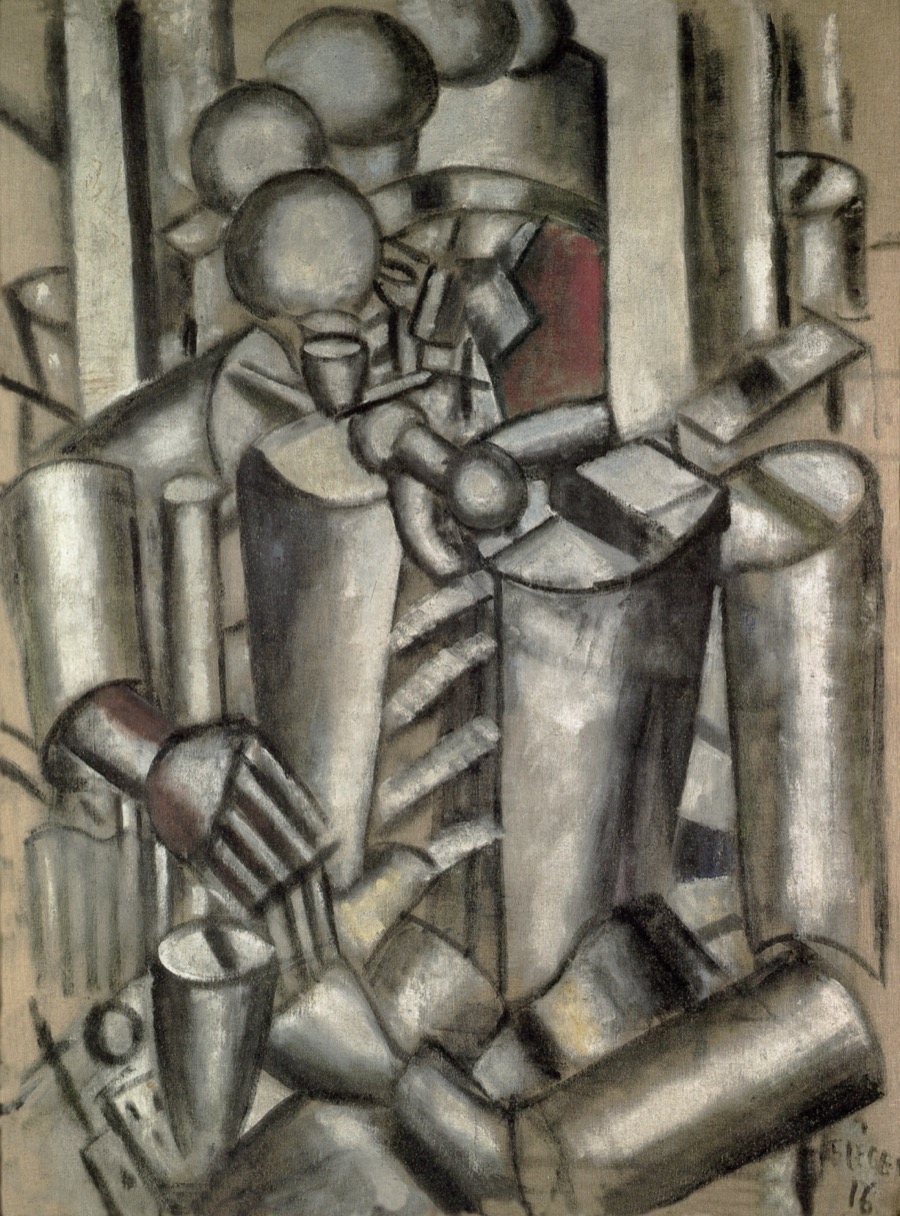
Léger is the Cubist who fell in love with the twentieth century. Where Braque and Picasso broke objects into fragile grey facets, Léger did the opposite: he built his forms up out of gleaming tubes, cones and cylinders, so consistently that critics coined the word 'Tubism' for what he was doing. A Léger canvas looks machined rather than painted — figures, trees and smoke alike are turned on an imaginary lathe, given a metallic sheen through bands of light and shadow, and locked together like the parts of an engine.
The second thing to look for is contrast as a principle. Léger deliberately collided opposites: curved against straight, flat colour against modelled volume, a stencilled letter against a human face. In his 1913 Contrasts of Forms series he pushed this almost to pure abstraction, letting red, blue, green and black shapes battle across the surface with the figure barely present.
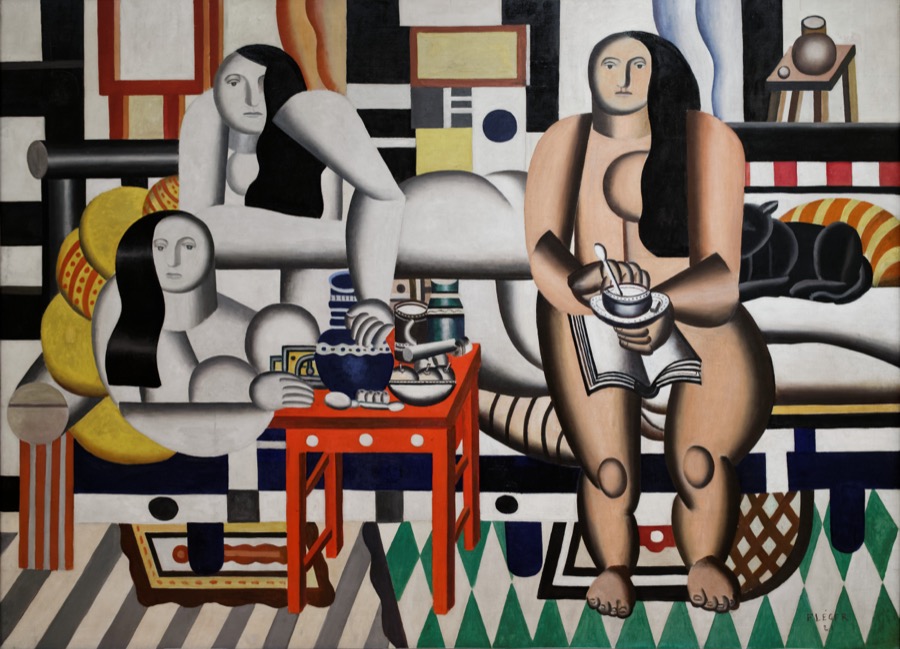
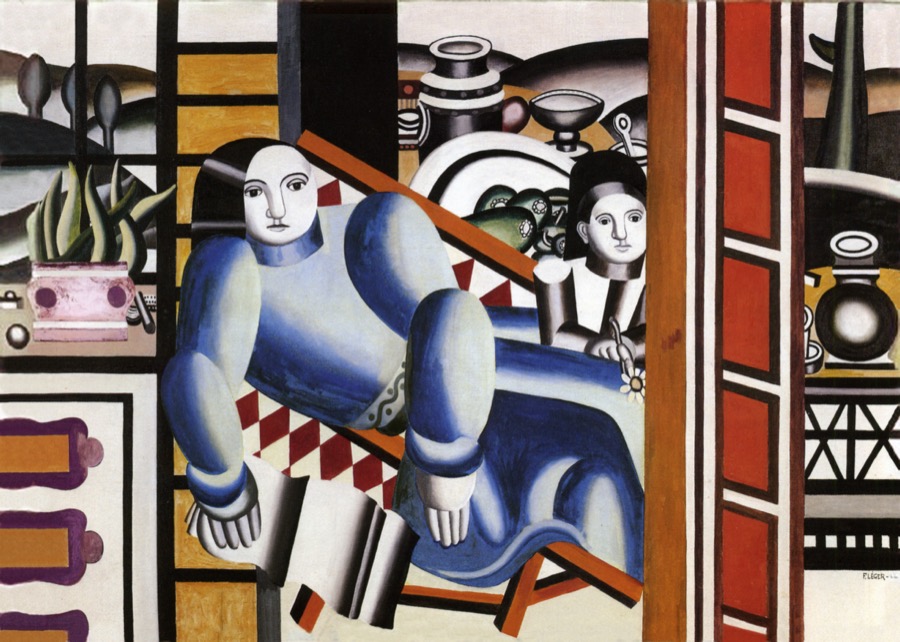
After 1918 the vocabulary hardens into the machine aesthetic — primary colours, thick black outlines, and forms that increasingly float free of their contours, so a plane of pure blue might sit beside a figure without describing it. Late Léger is instantly recognisable: bold, flat, cheerful, monumental, and populated by acrobats, cyclists, divers and construction workers rather than gods or aristocrats. If a painting treats a factory worker with the dignity a Renaissance master gave a saint — and builds him out of cylinders — you are almost certainly looking at a Léger.
Life and legacy
Born in Argentan, in rural Normandy, in 1881, Léger trained first as an architectural draughtsman — a discipline that never left his sense of structure. He arrived in Paris in 1900, absorbed the shock of the 1907 Cézanne retrospective, and by 1909–10 was moving in the Cubist circle around Picasso, Braque and the poet Apollinaire, though he always kept his distance from their muted, analytic manner.
The turning point was the First World War. Léger served at the front as a sapper and stretcher-bearer, was at Verdun, and was gassed in 1916. He later said the war 'made him a different painter': the breech of a 75mm gun glinting in the sun, and the comradeship of the ordinary soldiers around him, convinced him that modern machinery and ordinary working people were the true subjects of modern art. Out of this came his great 'mechanical period' — above all The City (1919), a hymn to the noise and colour of the modern street.
In the 1920s Léger reached far beyond the canvas. He co-directed the pioneering abstract film Ballet Mécanique (1924), designed sets and murals, and opened a teaching studio, convinced that art should belong to everyone rather than a wealthy few. His forms grew calmer and more monumental, his figures more openly human.
Politics and painting converged in his later years. Léger spent the Second World War in exile in the United States (1940–45), teaching at Yale and dazzled by New York's neon and industrial energy. He returned to France, joined the Communist Party, and devoted his final decade to celebrating labour and leisure — cyclists, picnickers and, most famously, the workers of The Builders (1950). He died at Gif-sur-Yvette in 1955, having spent his last years on murals, ceramics and stained glass that carried his democratic art onto the walls of the modern world.
Five famous paintings
The City 1919
Léger's manifesto for the machine age, and one of the most influential paintings of the 1920s. There is no single viewpoint and no story — instead the modern city arrives as a barrage of fragments: scaffolding, stencilled letters, poster colour, a staircase and two robotic grey figures who seem assembled rather than born. Léger keeps the picture flat and hard-edged, letting slabs of pure red, blue, yellow and green clash like competing billboards. He wanted to capture the tempo of the street — its signage, its speed, its cheerful visual chaos — and in doing so made urban modernity itself the subject of art.
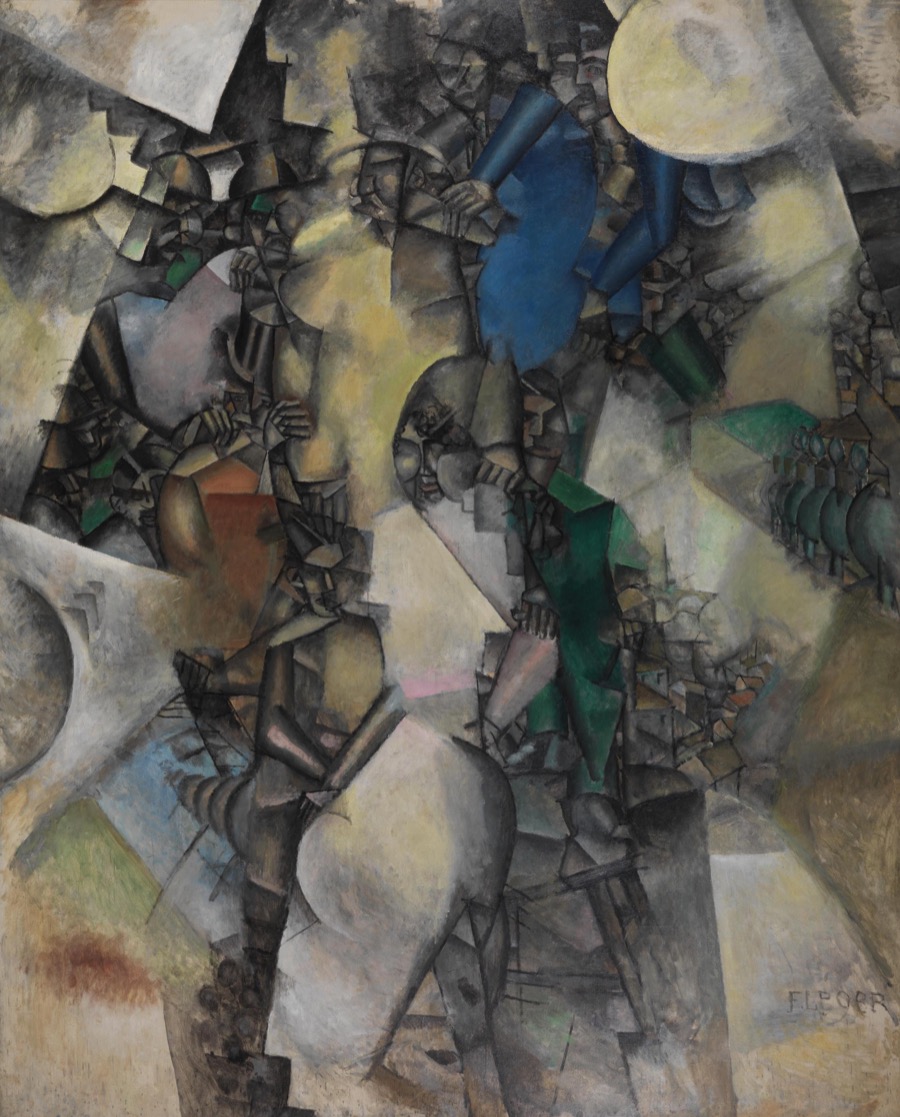
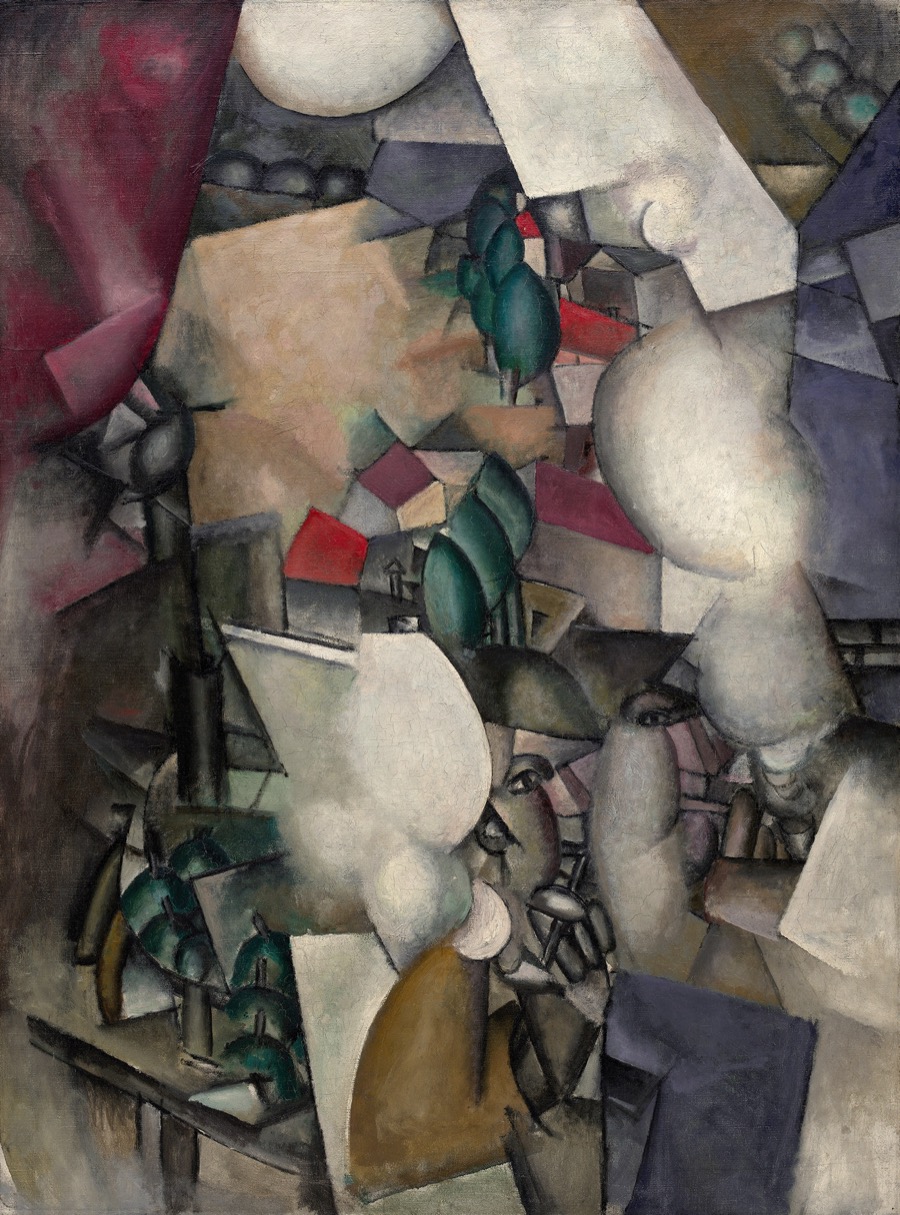
The Wedding 1911
One of Léger's earliest large Cubist statements, painted while he was still working out his difference from Picasso and Braque. A wedding procession dissolves into a cascade of smoky white and grey volumes — heads, hands and bodies rounded into tubes and cones and stacked up the canvas like billowing cloud. Fragments of a village, houses and foliage surface between the figures. Already you can see the future Léger: the insistence on rounded volume rather than flat facet, the structural, almost sculptural handling of the body, and a taste for turning a shared social ritual into pure pictorial rhythm.
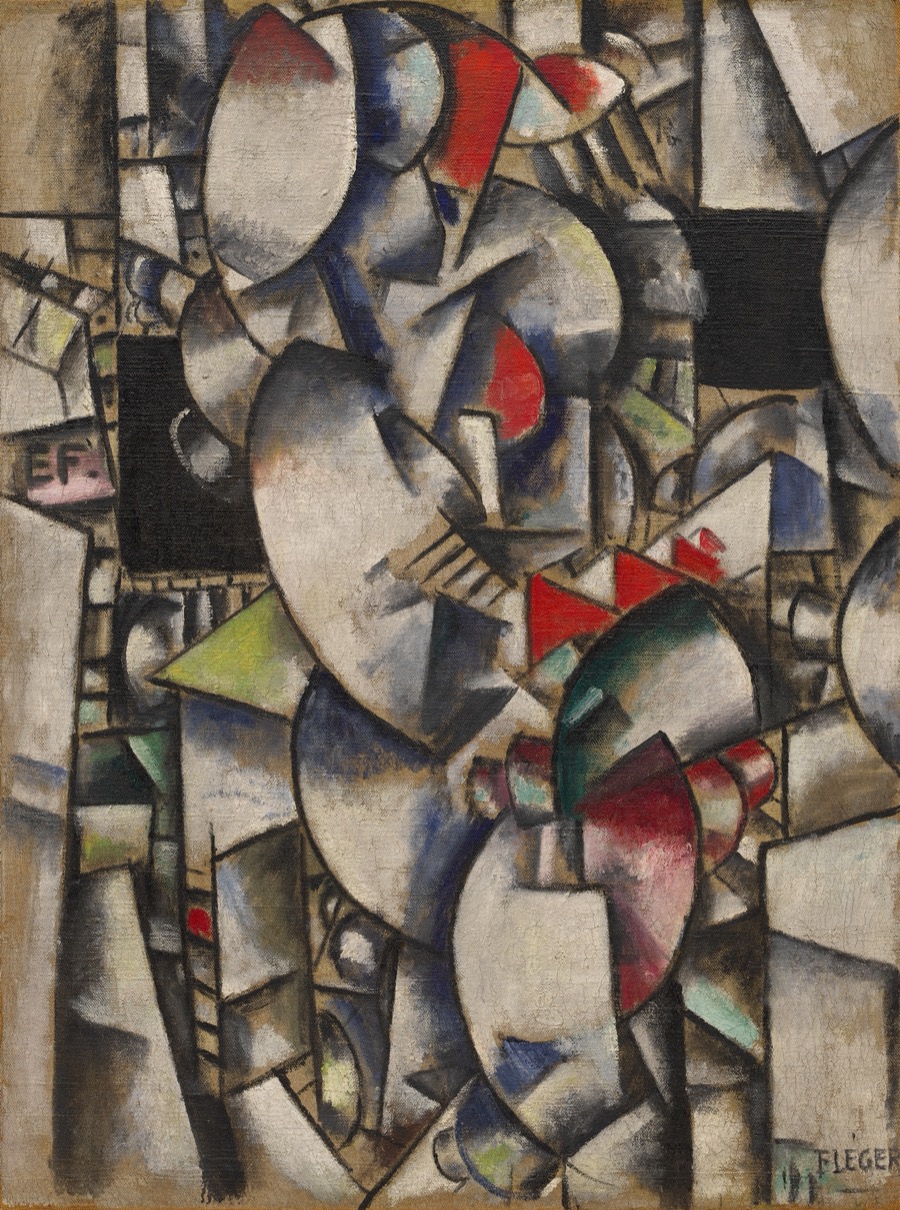
Nude Model in the Studio 1912
Here Léger pushes tubism to the edge of abstraction. The model and the studio around her are broken into the same brown, grey and white cylinders, so figure and setting are built from one shared vocabulary of curved metallic shapes. Bands of light and shadow give every form a machined, tin-like sheen. It is a picture less about a woman than about volume itself — how rounded solids can be locked together into a dense, humming structure. Works like this fed directly into his 1913 Contrasts of Forms, where the figure would almost vanish beneath the collision of pure shapes.
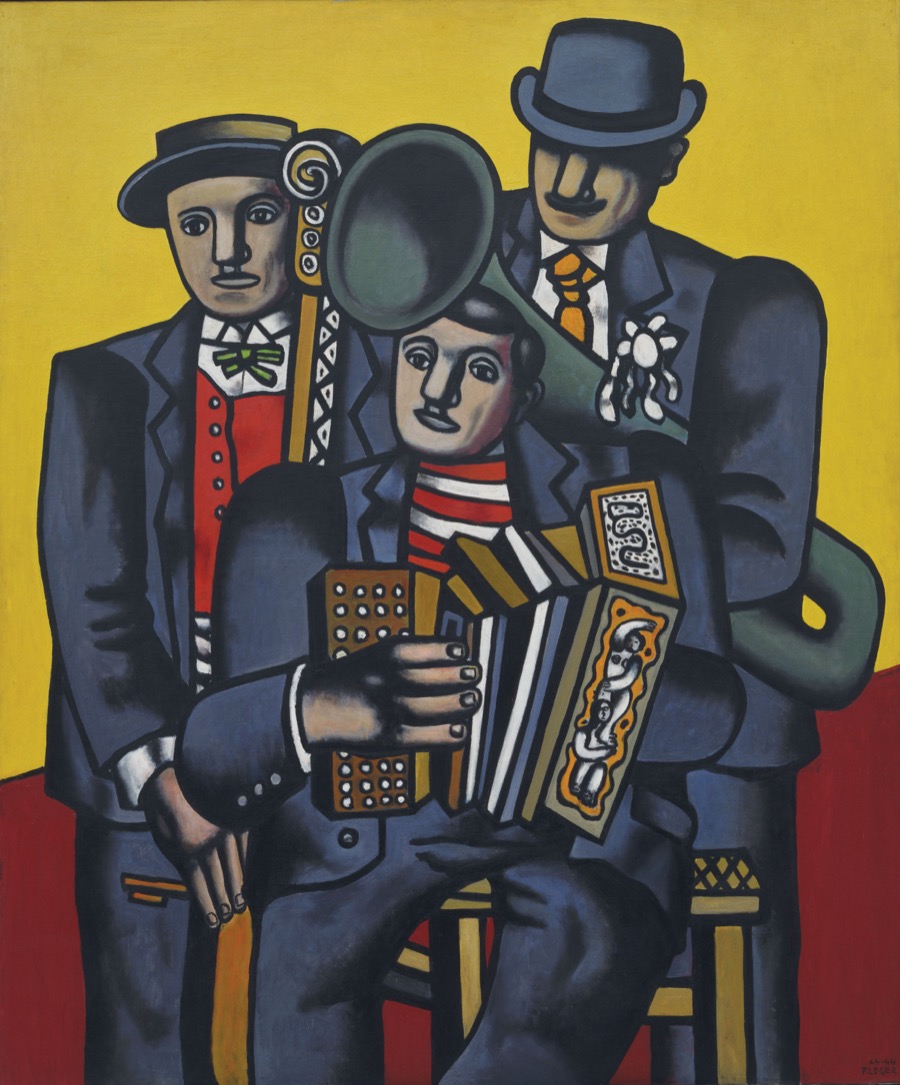
Three Musicians 1944
Begun from studies of the 1920s and completed during his American exile, this is mature Léger: three seated musicians rendered as flat, black-outlined figures in a shallow, poster-like space. The machined modelling of the mechanical period is gone; the bodies are now simple, monumental silhouettes filled with sober colour. Léger admired the directness of folk imagery and shop signs, and you can feel it in the frontal, deadpan clarity of the three faces. It is a painting about ordinary people and popular entertainment, treated with the calm grandeur he once reserved for machines.
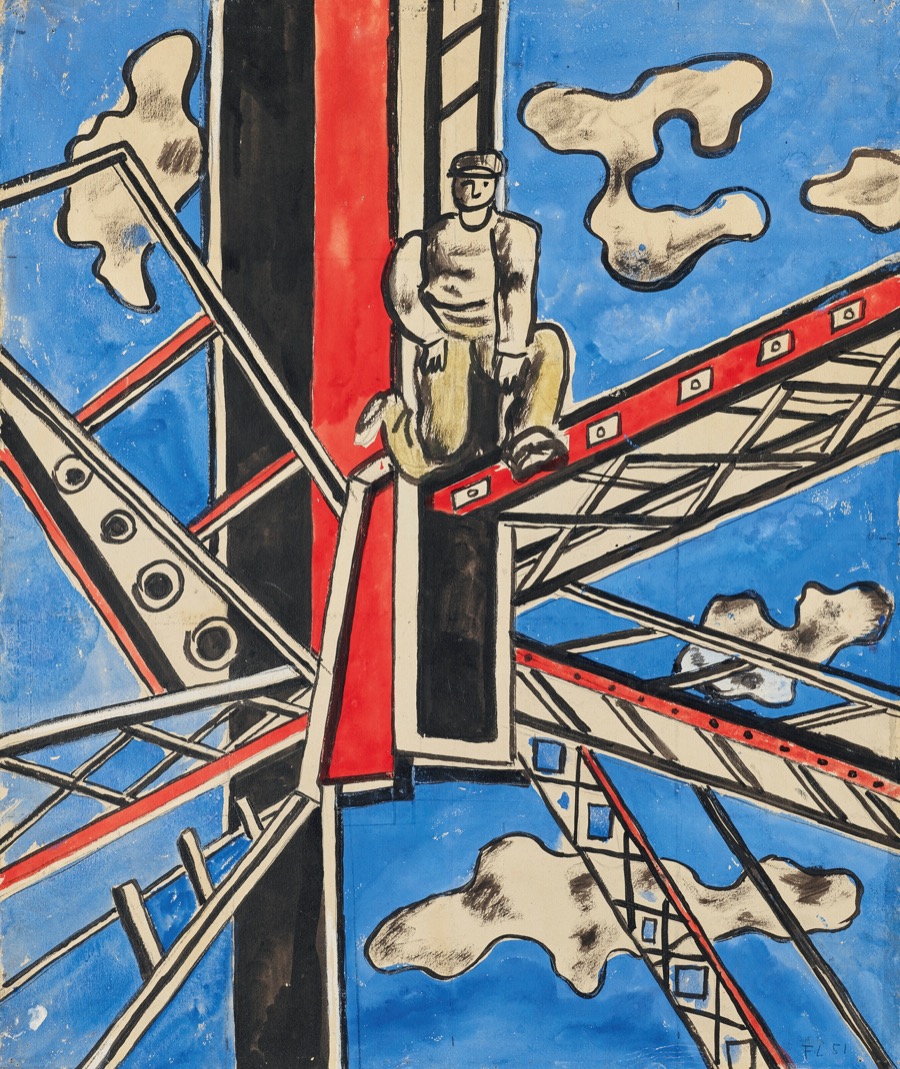
Study for The Builders 1950
Léger's great post-war theme was labour, and The Builders is its summit. Construction workers clamber across a lattice of girders against a bright sky streaked with clouds, their bodies as sturdy and rounded as the steel they handle. After his years in the Communist Party this was openly political art — a monument to the men who literally rebuilt France — but it is also purely Légerian: bold outlines, flat primary colour, and forms that hover between figure and machine. He made many versions; together they turn the ordinary worker into the hero of the modern world.